The Applied AI : Understanding the AI Landscape – Part 1 Blog Post 4

Working of the 4 Pillars and 5 Layers Framework

Introduction

Over the past three posts, I had shared the mental model for understanding the AI landscape piece by piece.

In Blog 2, I had introduced the 4 Pillars—the horizontal dimension that categorizes AI by where it is applied:

  • Consumer AI (speed and UX)
  • Enterprise AI (reliability and integration)
  • Science AI (precision and discovery)
  • Physical AI (safety and real-world interaction)

In Blog 3, we introduced the 5 Layers—the vertical dimension that tracks how various aspects of AI creates impact:

  • Hardware (Foundation)
  • Models (Intelligence)
  • Agents & Tools (Orchestration)
  • Applications (Interface)
  • Impact (Value)

Individually, each dimension is useful. But their real power emerges when you combine them into a matrix. In this post, we bring the two together—and I think the result will be the most practically useful idea you will learn.

The Building Construction Analogy: Why You Need Two Dimensions

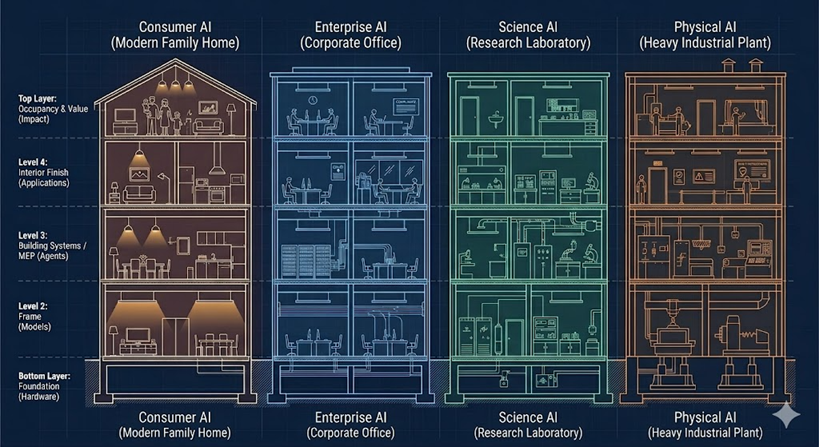
To start with wanted to use a simple Building Construction analogy to explain why combining pillars and layers matters.

Think about what it takes to construct a building. Before a single brick is laid, two questions define everything about how the project will be managed, what standards apply, and what failure means:

  1. What type of building are you constructing? A family home, a corporate office tower, a research laboratory, or an industrial plant?
  2. What phase of construction are you in? Laying the foundation, erecting the structural frame, running the building systems, finishing the interiors, or handing it over to occupants?

Either question alone tells you something. But neither tells you enough.

Knowing you are in the “electrical wiring phase” tells you the work involves circuits, conduit, and power loads. But it tells you nothing about what that work actually demands. Wiring a family home means standard outlets, consumer-grade cable, and a one-day inspection. Wiring a hospital means medical-grade isolation transformers, redundant emergency circuits, life-safety compliance reviews, and weeks of testing. The phase name is identical. The engineering reality could not be more different.

You need to know both the building type and the construction phase to understand what you are really dealing with.

This is exactly how the AI landscape works:

  • The Pillar tells you what type of “building” you are constructing—Consumer AI (a well-appointed home: built for comfort, speed, and personal delight), Enterprise AI (a commercial office tower: governed, integrated, inspected at every phase), Science AI (a precision research laboratory: every measurement matters, everything must be validated), or Physical AI (an industrial plant or a bridge: safety-critical, certified at every layer, because failure is not an option).
  • The Layer tells you what construction phase you are in—Hardware (the foundation and site work), Models (the structural frame), Agents & Tools (the MEP systems—mechanical, electrical, plumbing—the systems that make the building actually function), Applications (the interior finish: what occupants see and interact with), or Impact (occupancy and value: what the building delivers when people use it).

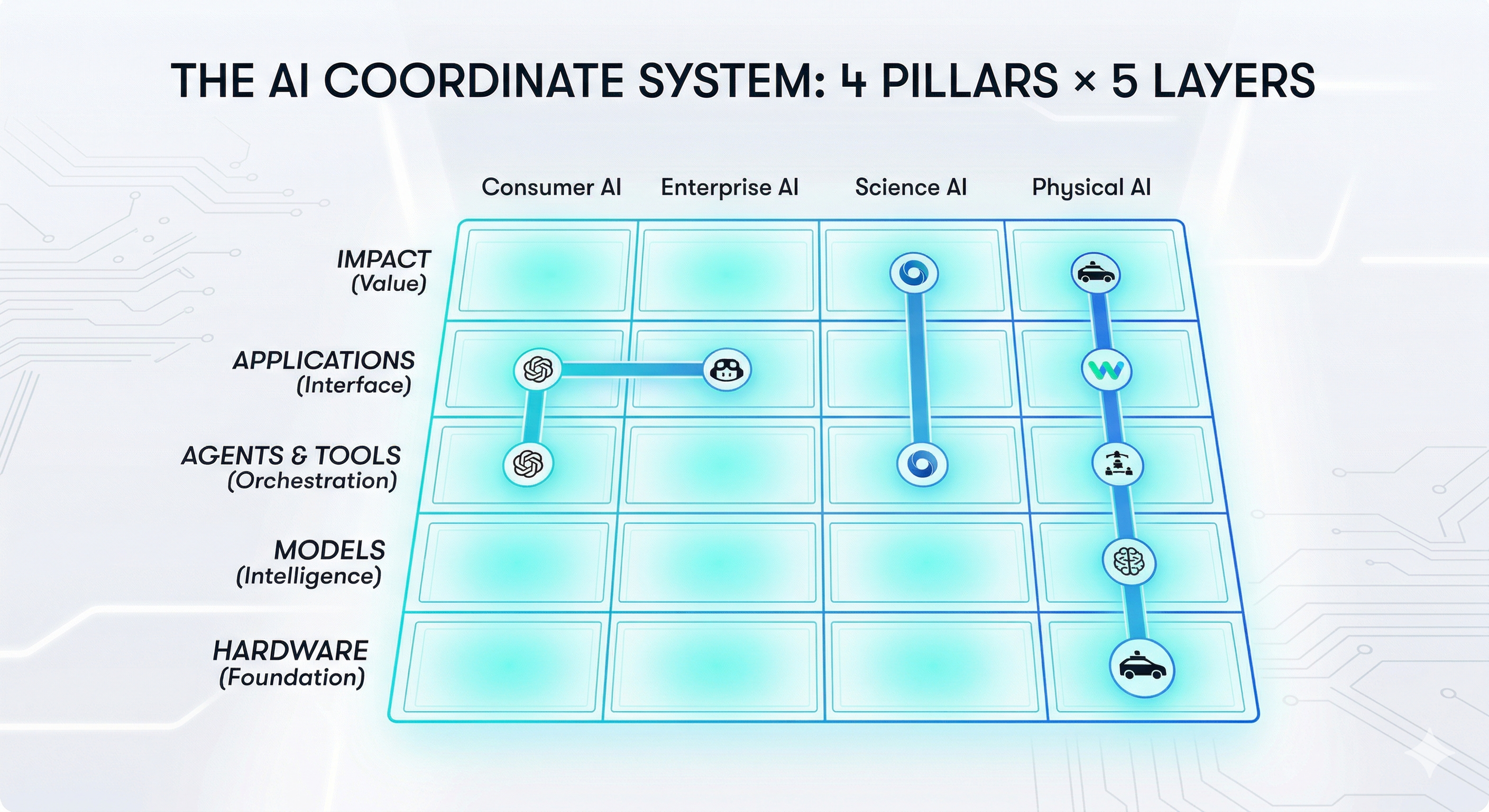
When you combine these two dimensions, you get a blueprint grid—a 4×5 matrix that lets you place any AI development into a specific, meaningful position. And just like an architect reading a blueprint instantly understands that “running MEP systems in a hospital” is an entirely different undertaking than “running MEP systems in a family home,” your position on this grid instantly reveals the constraints, timelines, and risks of any AI initiative.

The goal of this framework is not a classification exercise. It is to give you a decision tool—a way to read any AI initiative the way an experienced architect reads a blueprint: understanding what it truly demands before you commit to building it.

The Matrix: Your AI Blueprint Grid

When you are embarking on an AI initiative, the grid gives you four immediate questions to answer—each one revealing a different dimension of what the work actually demands:

  • Which layers require investment (Do you need custom hardware, or can you use existing infrastructure?)
  • What constraints will dominate (Is speed critical, or is accuracy non-negotiable?)
  • Where dependencies lie (Does your application layer depend on breakthroughs in the model layer?)
  • What adjacent developments matter (If you are building in Enterprise AI Layer 3, what’s happening in Consumer AI Layer 3 might signal future trends)

This blueprint grid transforms AI from an overwhelming landscape into a structured plan. Instead of asking “How do I keep up with AI?”, you can ask “What’s happening at the specific position in the grid which is my area of focus, and in the adjacent cells that matter?”

How the Same Layer Behaves Differently Across Pillars

Here is the key insight that makes this matrix powerful, not just being an academic excercise: the same layer behaves radically differently depending on which pillar you are in.

As with the wiring example—the phase name is the same, but the demands are not. Let me show you how this plays out with Layer 2 (Models), since that is the layer most people associate with “AI.”

  • A Consumer AI Model (like ChatGPT) is optimized for speed, creativity, and conversational flow. Accuracy is important, but a small mistake is forgiven. Users regenerate and move on.
  • An Enterprise AI Model used for financial reporting must be bulletproof. A hallucination here is not an inconvenience—it is a legal liability.
  • A Science AI Model (like AlphaFold) must model the laws of physics accurately. “Close enough” is not acceptable when the output determines whether a drug candidate moves to clinical trials.
  • A Physical AI Model controlling a robot arm must respond in milliseconds and never fail catastrophically. A wrong prediction is not a bad answer—it is a collision.

Same layer. Radically different behavior, constraints, and success criteria.

This pattern holds across every layer. To make it concrete, here is how Layer 1 (Hardware) and Layer 3 (Agents) look across all four pillars:

Hardware (Layer 1) Across the Pillars

Pillar Hardware Need Key Constraint Example
Consumer Smartphones, laptops, edge devices Cost and battery life—users won’t carry a $5,000 device Apple’s Neural Engine running AI locally on iPhones
Enterprise Cloud data centers with GPUs Cost per query at scale—$0.10 per query × 1M daily queries = unsustainable Microsoft Azure GPU clusters powering Copilot
Science HPC clusters, specialized TPUs Raw computational power—simulating molecular interactions requires massive parallelism Google’s TPU pods training AlphaFold
Physical Edge compute on robots, real-time processors Ruggedness and power efficiency—a warehouse robot can’t be plugged into a wall NVIDIA Jetson chips in autonomous delivery robots

Agents & Tools (Layer 3) Across the Pillars

Pillar Agent Role Key Constraint Example
Consumer Personal assistants for daily tasks User trust and simplicity—complexity drives abandonment Google Assistant coordinating calendar, email, and maps
Enterprise Workflow automation (tickets, reports, routing) Reliability and auditability—a wrong ticket priority creates business risk Salesforce Einstein automating support triage
Science Research agents proposing hypotheses, searching databases Accuracy and domain expertise—a wrong hypothesis wastes months of lab work AI agents in drug discovery suggesting molecular candidates
Physical Control agents coordinating sensors, motors, navigation Real-time safety—a 100ms delay can cause a collision Waymo’s vehicle agent orchestrating perception, planning, and control

The Speed Paradox: Why Each Pillar Evolves Differently

One of the most practically useful insights from this framework is understanding why different AI domains move at different speeds. This is something I wish more people internalized, because it is the antidote to AI FOMO.

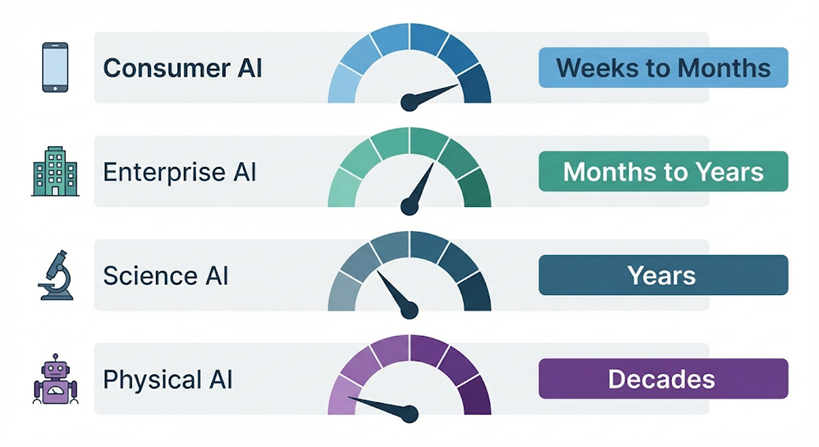
Consumer AI moves at software speed. New features ship weekly. ChatGPT’s interface changes monthly. A startup can go from idea to launch in weeks. Why? Because the constraints are lightweight—you need a fast model, a clean UI, and an internet connection. Layer 1 (Hardware) is someone else’s problem (cloud providers). Layer 5 (Impact) is measured in engagement, not life-or-death outcomes.

Enterprise AI moves at integration speed. Deployments take months to years. Why? Because Layer 3 (Agents) must connect to legacy systems, Layer 4 (Applications) must satisfy compliance and security reviews, and Layer 5 (Impact) must be measured in ROI—not vibes. Every new AI capability must pass through governance, procurement, and change management before it reaches a single employee.

Science AI moves at validation speed. Breakthroughs like AlphaFold take years to move from paper to practice. Why? Because Layer 5 (Impact) requires peer review, reproducibility, and cross-domain validation. A model that predicts protein structures must be verified by wet-lab experiments before anyone trusts it for drug design. Science AI changes humanity quietly—you rarely see it in headlines, but its long-term impact often exceeds everything else.

Physical AI moves at certification speed. Self-driving cars and surgical robots operate on timelines measured in decades. Why? Because every layer must be near-perfect simultaneously. Layer 1 (Hardware) must survive rain, heat, and impact. Layer 2 (Models) must handle edge cases that have never been seen before. Layer 5 (Impact) involves human safety, which means regulatory certification, insurance frameworks, and public trust—all of which move slowly and for good reason.

Why this matters to any one involved in rolling out AI initiatives: When you see a headline about a “breakthrough” in Physical AI, you can breathe. It will be years before it affects your daily work. When you see a breakthrough in Consumer AI, pay attention—it might change your workflow next month. The pillar tells you how fast the building codes—and the industry around them—are rewritten.

Applying the Framework: A Quick Start

Now that you have seen the matrix in action, here is a quick way to use it when you encounter any AI announcement, product, or project. I will expand this into a full practical methodology in Part 3 of the series, but for now, three questions will get you most of the way:

Question 1: Which pillar? Identify the building type. Is this consumer-facing, enterprise, scientific, or physical? The pillar immediately tells you the dominant constraint (delight, integration, accuracy, or safety) and the likely pace of development—just as knowing whether you are building a home or a hospital tells you immediately what standards, timelines, and failure tolerance apply.

Question 2: Which layers? Identify the construction phase. Which layers is this project investing in? If a company announces a “revolutionary AI product” but only focuses on Layer 2 (the model), it may lack the MEP systems (Layer 3 / Agents) or the finished interior (Layer 4 / Applications) to be usable. You can spot vaporware by identifying the phases that are missing or hand-waved away.

Question 3: Does this affect my position on the grid? The framework gives you permission to ignore 75% of AI news. If an announcement is not in your pillar or an adjacent layer, it is noise. A Science AI breakthrough (like AlphaFold) is fascinating, but if you are building consumer products, it is not immediately actionable.

Example: You read: “New multimodal AI model can understand video, audio, and text simultaneously!”

  • Pillar: Likely Consumer AI (user delight) or Enterprise AI (workflow efficiency).
  • Layers: Primarily Layer 2 (model improvement). But does it have Layer 3 integration or Layer 4 UX?
  • Relevance: If you are building a video editing tool (Consumer), this is highly relevant and could reach your users in months. If you are in healthcare (Enterprise/Science), wait for domain-specific validation—it will take 1-2 years for integration.

In seconds, you have gone from “another overwhelming AI headline” to “I know exactly what this means for me.” That is the power of knowing your position on the grid.

Summary

In this post, we brought together the two dimensions of our framework—the 4 Pillars (where AI applies) and the 5 Layers (how AI creates impact)—into a single coordinate system.

The key insights:

  • The matrix is a decision tool, not just a classification. Like a construction blueprint, your position on the grid reveals the building type (constraints), the construction timeline, and the safety requirements of any AI initiative.
  • The same layer behaves radically differently across pillars. “Models” in Consumer AI means fast and forgiving. “Models” in Physical AI means flawless and real-time. The layer name is identical; the engineering reality is not.
  • Each pillar evolves at its own speed. Consumer AI moves in weeks, Enterprise in months, Science in years, Physical in decades. Understanding this eliminates FOMO and helps you set realistic expectations.
  • You can ignore 75% of AI news. Once you know your building type and construction phase, any announcement outside your pillar and adjacent layers is background noise—interesting, but not actionable for you right now.

With this blog the Part 1 of the blog series is now complete. You now should have a full mental model for understanding the AI landscape. But understanding the structure is just the beginning.

What’s Coming Next: Deep Diving Into Each Pillar

The blog posts in Part 2 of this series, we will take a detailed journey through each pillar, one at a time:

  • Consumer AI: Where AI meets individual users. We will explore personalization, ambient computing, and the race for zero-friction interfaces.
  • Enterprise AI: Where AI meets business processes. We will discuss agentic workflows, data readiness, and why most AI pilots fail.
  • Science & STEM AI: Where AI accelerates discovery. We will look at AI-generated hypotheses, autonomous labs, and humanity-scale breakthroughs.
  • Physical AI: Where AI enters the real world. We will examine robotics, autonomous systems, and the long game of building trust.

Each pillar will be analyzed through the 5 layers, with specific trends, constraints, and decision-making guidance.

By the end of Part 2, you will not only understand the landscape—you will know how to navigate it.

Author’s Note: AI-assisted writing tools were used to support the creation of this post. All concepts, perspectives, and the underlying thought process originate from me; the AI served only as a drafting and refinement aid

Published by Sri Rajalingam

CTO, Entrepreneur, Technology Evangelist & Trainer focused on building companies and helping Enterprises Apply and Adopt AI and Cloud to that cna help them to create real, measurable impact. View all posts by Sri Rajalingam

Rethinking Enterprise Scaling in the Era of GenAI – Post 1 – How GenAI Unlocks a Smarter Growth Playbook

Introduction

Rethinking Enterprise Scaling in the Era of GenAI is four-part series to share my PoV on how Generative AI fundamentally changes the concept of enterprise scale — not as a technology topic, but as a strategy and operating model challenge. Each post will build upon the last, moving from foundational philosophy to practical execution to financial justification.

This is the Part 1 of 4 in the series: How GenAI Unlocks a Smarter Growth Playbook


The Assumption That is Quietly Expiring

Here is a belief so fundamental to enterprise strategy that most leaders have never had to question it:

To grow, you must add.

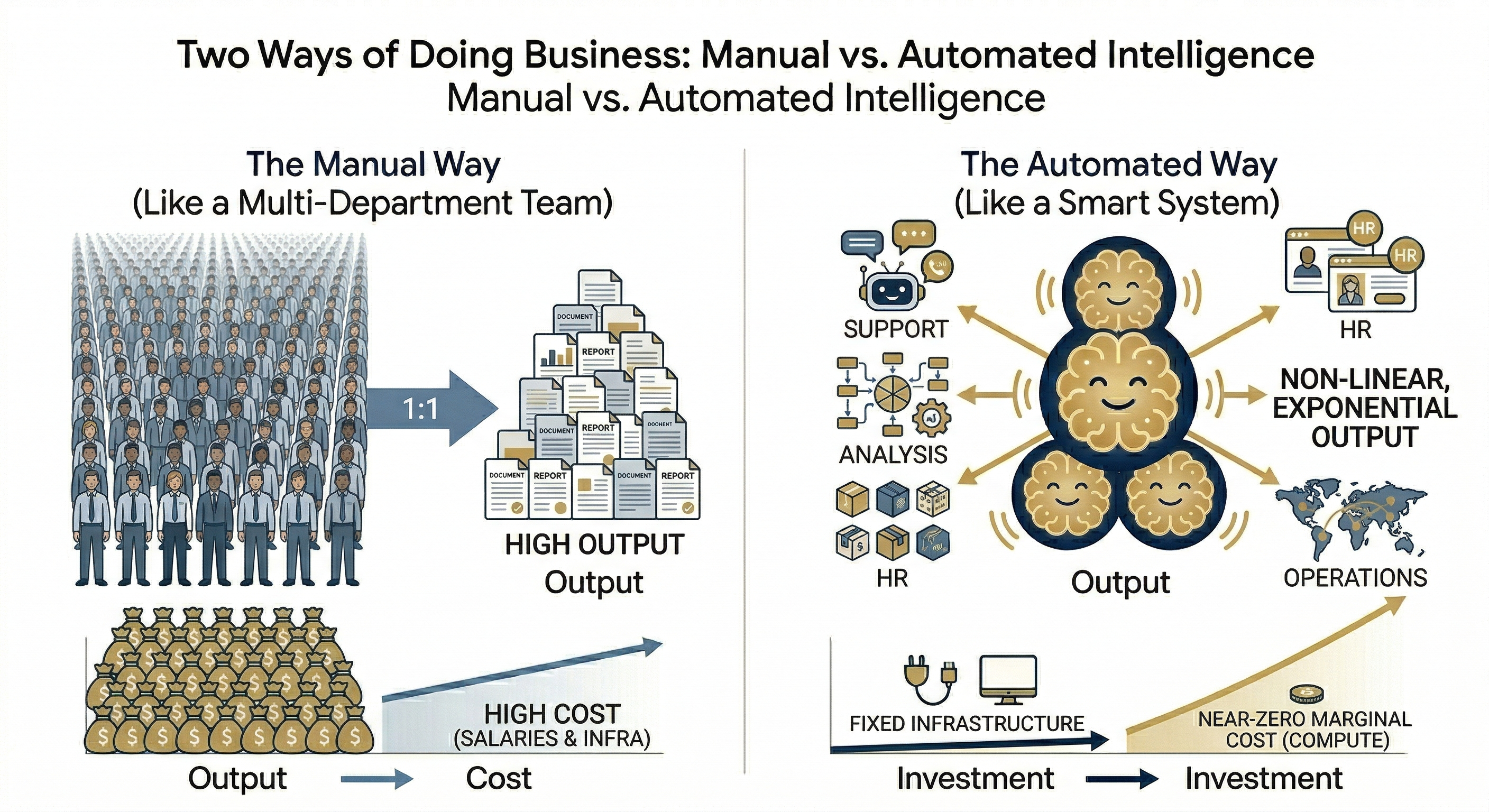
Add people to increase output. Add servers to increase throughput. Add processes to increase control. Scale, by definition, meant proportional resource expansion. The more volume you needed to handle, the more headcount you hired. The more throughput you needed, the more infrastructure you provisioned. Growth and cost moved together in a predictable, linear lockstep.

This model worked well for decades. It shaped how consulting frameworks were built, how transformation programs were designed, and how the entire discipline of enterprise architecture evolved.

GenAI is expiring this thinking.

Not gradually. Not partially. The foundational relationship between resources and output that has governed enterprise growth strategy for a generation is changing and being broken. The enterprises that continue to operate on the old assumption will find themselves scaling costs faster than they scale results compared to their competition who would adopt GenAI to scale who will be able to scale results more with marginal cost.

This post is about understanding why that shift is happening, what it means for how you think about growth, and why it demands a fundamentally new playbook.


The Old Equation: Linear Scale

The traditional enterprise scaling model can be expressed simply: Output ∝ Resources

More resources in, more output out. This wasn’t just a financial formula — it was the organizing logic of every major business function:

  • Sales: Grow revenue by growing the sales team.
  • Customer Operations: Handle more customers by hiring more agents.
  • IT: Process more transactions by provisioning more infrastructure.
  • Knowledge Work: Produce more analysis by adding more analysts.

The model had enormous merit. It was predictable. It was manageable. It gave CFOs firm ground to stand on when building growth projections. But it came with an inescapable constraint: growth required proportional investment. Every new dollar of revenue had to be earned by spending a near-equivalent dollar on resources to deliver it.

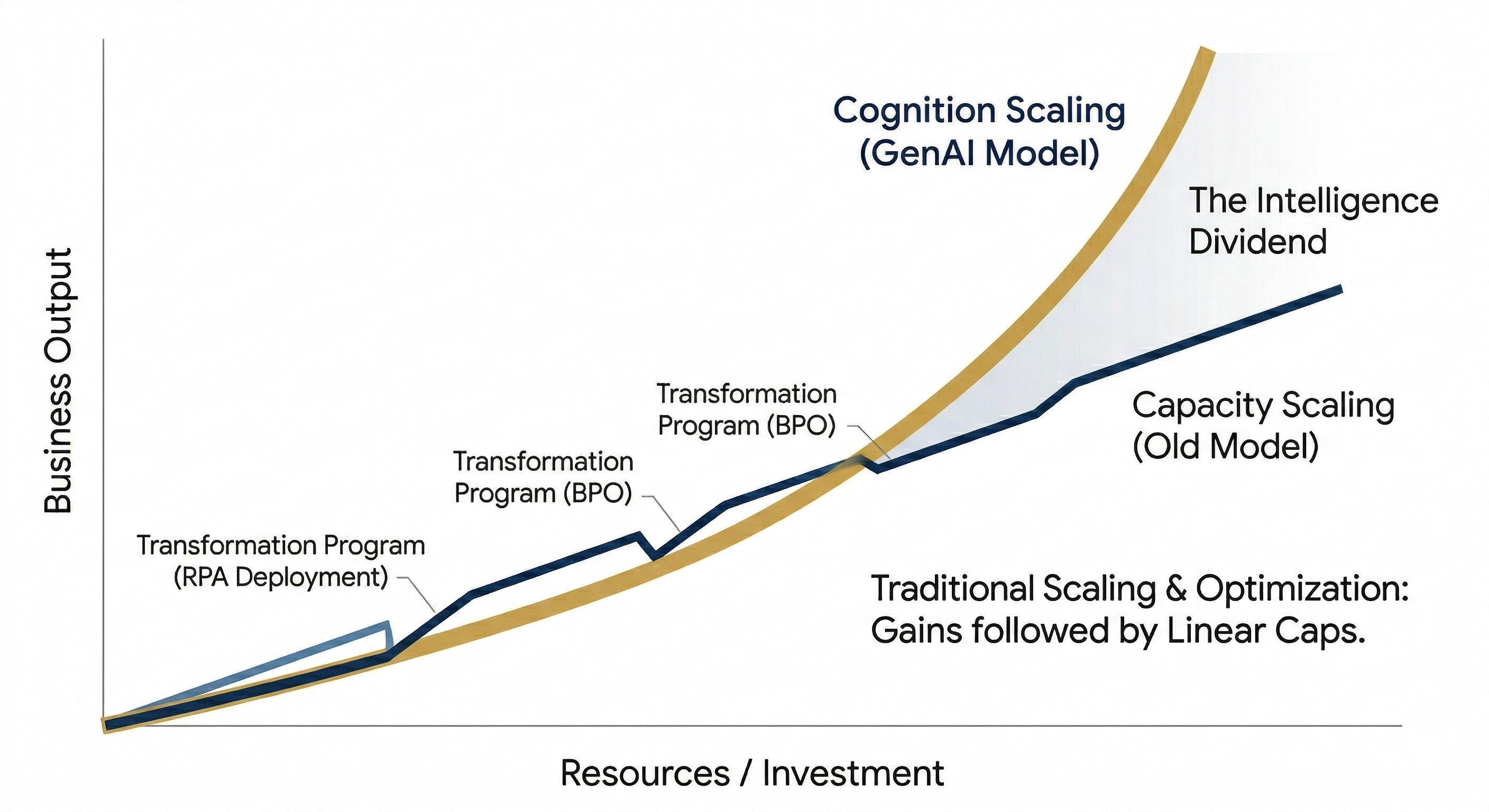
Enterprise transformation programs for the past two decades — whether ERP rollouts, CRM implementations, cloud migrations, or RPA deployments — were primarily optimizations within this linear model. They made the slope more efficient. They reduced the cost per unit of output. But they didn’t break the fundamental relationship. The line remained linear. It just got steeper.

GenAI doesn’t optimize the slope. It changes the shape of the curve. Below images shows that difference between the old and the new model of scalling.


The New Equation: Cognition Scaling

With GenAI, a more accurate equation emerges: Output ∝ Intelligence × Automation × Context

A single AI agent trained on an enterprise knowledge base can handle thousands of customer support interactions simultaneously — interactions that would previously have required a proportional team. A language model deployed in a sales workflow can draft proposals, surface competitive insights, and personalize outreach at a volume normal human team could not match. An AI-assisted IT operations platform can detect anomalies, trace root causes, and trigger remediation without the requirement for a human required to act on a ticket.

The scaling variable is no longer manpower or infrastructure capacity. It is intelligence — and intelligence, once built, can be replicated at near-zero marginal cost.

This is the shift from capacity scaling to cognition scaling. And it is not incremental. It is structural.

Dimension Capacity Scaling (Old) Cognition Scaling (New)
Growth driver Resources added Intelligence applied
Cost behavior Linear with output Near-fixed once deployed
Bottleneck Headcount / Infra Orchestration / Governance
Competitive advantage Operational efficiency Speed and adaptability
Output ceiling Bounded by budget Bounded by design quality

The implications extend far beyond cost. When intelligence can be replicated, expertise is no longer scarce or localized. A single senior engineer’s knowledge, codified into an AI agent, can resolve 70% of support tickets without that engineer being present. A handful of specialist analysts, augmented by AI, can deliver insights across an entire enterprise that previously required a department. The Key thing to understand is, You don’t just scale headcount — you scale expertise distribution.


The Evolution of the Traditional PPT Model — and GenAI Is Leading the Way

To understand the full magnitude of this shift, it helps to go back to a framework that every enterprise consultant has lived by: People, Process, Technology — the PPT model.

The PPT model positioned transformation as a balanced act across three dimensions. In theory, people, process, and technology were equal pillars. In practice, something very different happened.

Because enterprise technologies like — ERP systems, CRM platforms, BPM engines — was inherently rigid, it was almost always the constraint that everything else had to adapt to. Projects followed a predictable, uncomfortable pattern:

  1. Select the platform
  2. Reengineer processes to fit the platform’s workflow logic
  3. Retrain people to comply with the new processes

The human and process layers were routinely force-fitted to the technology. The phrase “change management” became a polite euphemism for pushing an organization through the friction of adapting to a system it didn’t design. Billions in transformation budgets were spent not on genuine capability improvement or drive major improvements to outputs, but on organizational adaptation to rigid software that some times helped only to marginal improve outputs.

GenAI introduces something the PPT model was never built to accommodate: adaptive technology.

For the first time in enterprise history, technology is no longer the rigid layer that everything else must bend around. Consider what this means in practice: a traditional ERP system required a purchase order to follow a fixed sequence of steps — approve, validate, route, post — regardless of context. A GenAI system can read an email from a supplier, understand that it contains an urgent pricing exception, and trigger the right escalation path without anyone defining that path in advance. It responds to intent — what the business is trying to achieve — rather than instruction — a pre-coded sequence of steps it must be told to follow. It adapts to how your organization actually communicates, rather than forcing your organization to communicate in ways the system can parse. And because it learns from interaction over time, the system improves through use rather than requiring a formal change request every time a process needs to evolve.

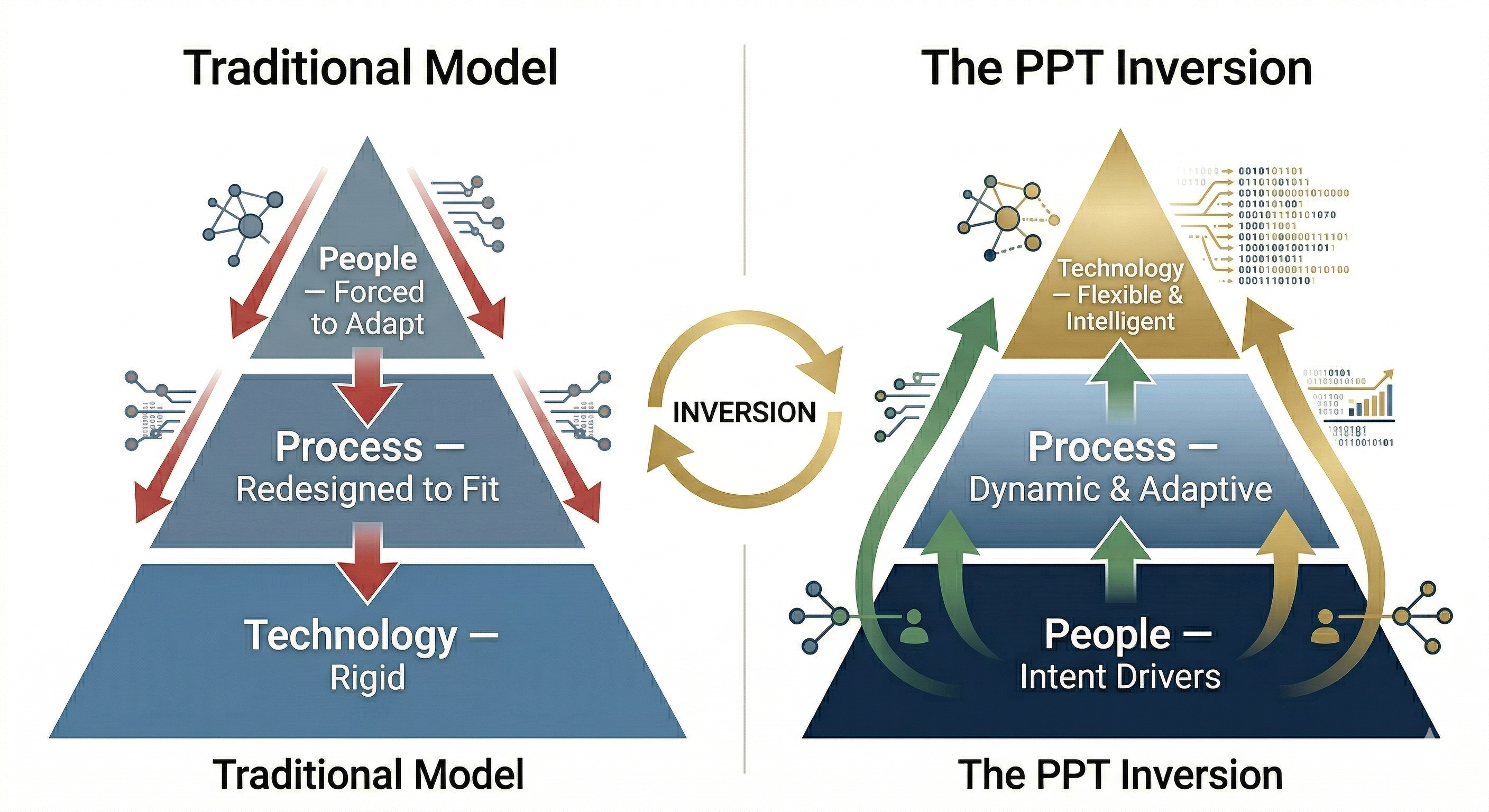
This is what we call the PPT Inversion:

In the traditional PPT model, technology was always the immovable anchor. Systems were purchased, installed, and then the organization was reshaped around them — processes rewritten, people retrained, workflows contorted to match what the software could accommodate. The technology constrained everything above it.

The PPT Inversion describes what happens when that relationship flips. GenAI is the first enterprise technology that can genuinely adapt to the organization, rather than requiring the organization to adapt to it. People become the drivers of intent — defining what outcomes matter. Technology becomes the most flexible layer — figuring out how to achieve them. Process becomes dynamic — emerging and evolving between the two, rather than being prescribed in advance.

Old Model The PPT Inversion
Technology is fixed; people adapt Technology adapts; people drive intent
Processes are redesigned to fit systems Systems generate and evolve processes
Change management = retraining to comply Change management = redefining roles
“Fit the organization into the system” “System shapes itself around the organization”

The PPT Inversion doesn’t eliminate the three pillars. People, process, and technology remain essential. But their roles are redistributed:

  • People move from system users and process executors to intent drivers and supervisors of AI.
  • Processes move from rigid, pre-designed blueprints to dynamic, adaptive intelligence flows.
  • Technology moves from a system of execution to a system of cognition — the most flexible layer, not the most constraining one.

For the first time in enterprise history, technology is no longer the rigid layer — it is becoming the most flexible layer.

This is not a minor philosophical update. It fundamentally changes how enterprises should think about transformation. The question shifts from “How do we get our people to adapt to this new system?” to “How do we design intelligence that amplifies how our people naturally work?”


What Stayed the Same — and Why That Matters

It would be easy to get carried away by the hype and to overstate the case. GenAI is transformative, but it is not unconditional.

Two critical things have not changed:

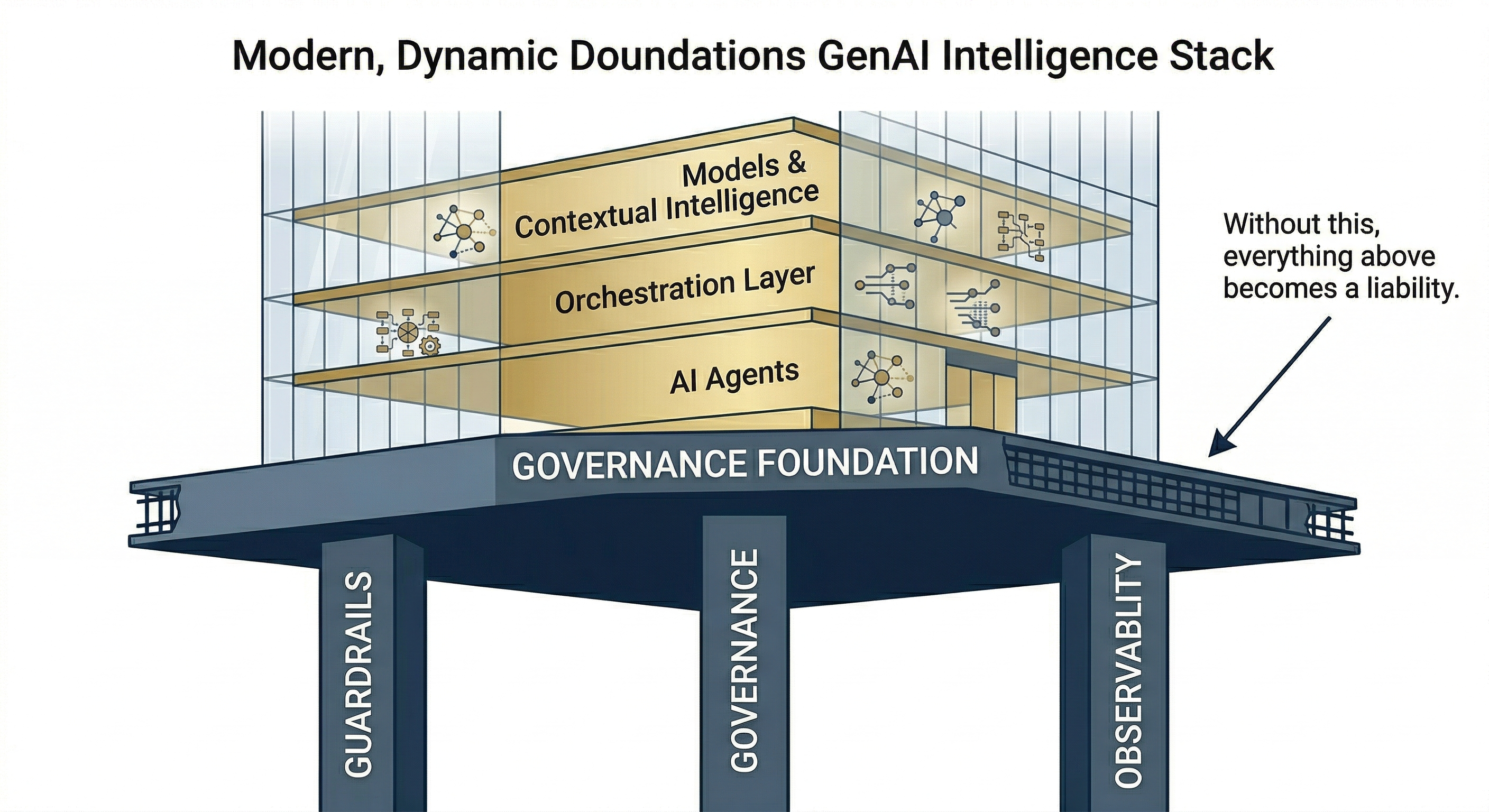
First, the precision requirement. Non-linear scale amplifies both the upside and the exposure. When an AI agent operates across thousands of simultaneous interactions, the blast radius of a logic error shifts from a single transaction to an entire workflow. Hence it is critical to ensure Governance, guardrails, and observability are not optional additions to a GenAI strategy. They are load-bearing infrastructure. The intelligent operating models we explore throughout this series are built on the assumption that these foundations are in place. (Governance architecture is a dedicated topic — one we’ll address separately in this series.)

Second, the complexity of orchestration. The new bottleneck in cognition scaling is not capacity — it’s orchestration. Coordinating multiple AI agents, managing shared context, aligning tool usage with business outcomes, and maintaining consistency across intelligence pipelines requires sophisticated design. Enterprises that invest only in AI models and deploying AI Agents without investing in orchestration will find themselves with powerful tools they cannot reliably harness.

Scaling intelligence requires stronger control systems than scaling infrastructure.


The opportunity is real. But so is the design challenge.


A Preview of What is Coming Next

This shift in the scaling paradigm shared in this post is just the foundation. It has a cascading impact that flow through every dimension of enterprise operations that demands the enterprises to carry out new way of thinking.

The series ahead maps four of those dimensions in the next set of posts:

Post 2 — The Operating Model: When the growth equation changes, the enterprise operating model has to change with it. We’ll map how GenAI transforms five layers of enterprise operations — from leadership decision-making to frontline execution — and why the future operating model is built on intelligence loops, not process pipelines.

Post 3 — The Execution Strategy: Non-linear scale does not mean uniform automation. Enterprises need a practical framework for deciding where to apply full AI autonomy, where to deploy AI as an augmentation layer, and where to keep humans firmly in control. Post 3 introduces the GenAI Operating Spectrum — three modes, one decision framework.

Post 4 — The Financial Case: None of this matters unless it translates to business outcomes. Post 4 addresses the CFO conversation directly — mapping each dimension of the framework to measurable financial levers, and introducing a three-layer ROI model that captures the full value of intelligence investment, not just the efficiency gains that most cost-benefit analyses miss.


The Question Every Enterprise Leader Should Ask Today

The old growth playbook assumed that scale was a capacity problem. Buy more. Hire more. Build more.

GenAI reframes it as a cognition problem. Design better. Orchestrate smarter. Deploy intelligence where it creates the most leverage.

The enterprises that recognize this shift now will have a structural advantage that compounds over time. Those that optimize their existing linear model — however elegantly — will find their competitors who are levaraging on GenAI reaching entirely different points on a different curve.

The question is not whether your organization will adopt GenAI. The question is whether you will adopt it as a tactical tool, or as a new architecture for scale.

There is a significant difference between those two answers — and the choice enterprises make now will define their growth ceiling for the next decade.


This is Post 1 of 4 in the series “Scaling in Enterprises in the Era of GenAI.” Post 2 — “Rewiring the Enterprise: How GenAI Transforms Your Operating Model End-to-End” — explores how the five layers of enterprise operations must be redesigned when intelligence, not process, becomes the organizing principle.


The ERP Awakening : The Day 2 Hangover – Governing a GenAI Driven System That Won’t Sit Still

This is the final installment of the “Beyond the Hype” series. In Part 1, we defined the vision of the “System of Intelligence.” In Part 2, we covered the “Day 1” implementation reality of data hygiene and trust.

We began this Series by reimagining the ERP system and its data not as a data warehouse, but as an active partner which is a shift of viewing ERP as a “System of Record” to “System of Intelligence.” We then navigated the “Day 1” implementation challenges, the importance of prioritizing data hygiene and “Glass Box” engineering prioritizing transparency and explainability to bridge the trust gap. Now, we arrive at the most critical phase.

The implementation phase of a Generative AI (GenAI) project generates significant enthusiasm with a “Go-Live” celebration. The system has been deployed, the initial use cases are functioning, and the users are cautiously optimistic. However, the true challenge of an AI-augmented ERP begins the morning after deployment.

Unlike traditional software modules, which remain static until explicitly patched, GenAI agents utilize probabilistic models that interact with dynamic data. This introduces a fundamental instability: the system behavior decays without active intervention. “Day 2” operations are not merely about maintaining uptime; they are about maintaining alignment. For a GenAI-augmented ERP, uptime is necessary but insufficient. A system can be 100% available yet still be misaligned — confidently generating wrong answers, drafting obsolete contracts, or producing biased recommendations. The system must continuously be steered back toward the organization’s current business rules, data reality, and intended behavior. This is the core challenge the rest of this post addresses.

In this post, we examine the critical “Day 2” operational challenges of a GenAI-augmented ERP — the forces that cause system behavior to erode over time. We will address the concept of “Drift,” the hidden costs of AI cognition, and the governance frameworks needed to keep the system aligned with your business reality.

The New Reality of “Drift”

In a traditional ERP environment, a configured business rule (e.g., “PO approval limit > $5000”) remains true forever unless code is changed. In a GenAI-augmented environment, the system’s output is a function of both the context data it retrieves and uses from a RAG repository and the model it uses to interpret that data. Both variables are subject to “Drift.”

Data Drift: The Context Shift

ERP data is highly dynamic. New General Ledger (GL) accounts are created, product lines are discontinued, and vendor payment terms are renegotiated. A GenAI model prompted to “Draft a standard procurement contract” relies on the underlying data to be current. If the business logic changes (e.g., a new sustainability clause is required for all vendors), but the vector database or knowledge base is not updated, the AI will confidently generate obsolete contracts. This is Data Drift: the divergence between the model’s knowledge and the business’s reality.

Model Drift: The Behavior Shift

The underlying Large Language Models (LLMs) are also subject to updates by their providers. A model prompt that generated a concise summary in version 3.5 might produce a verbose or hallucinated response in version 4.0. This Model Drift means that even if the business data remains constant, the system’s output can change unpredictably. The “deterministic” stability of the ERP is replaced by “probabilistic” fluidity when we augment it with GenAI.

The Financial Surprise: Managing the Cost of Cognition

The operational expense (OpEx) of traditional software is generally predictable (license fees + hosting). The OpEx of a GenAI system is consumption-based and highly variable. Every interaction consumes “tokens,” and complex reasoning tasks cost significantly more than simple retrieval tasks.

Without governance, the “Cost of Cognition” can spiral out of control. A user asking the system to “Summarize the last 10 years of sales data” might trigger a massive, expensive query operation that could have been handled by a standard report.

The Solution: Tiered Architecture

Financial governance requires a tiered approach to model selection:

  • Tier 1 (Routing/Simple): Use smaller, faster, cheaper models (SLMs) for basic intent classification and simple lookups.
  • Tier 2 (Complex Reasoning): Reserve powerful, expensive reasoning models (LLMs) only for complex exceptions and creative generation tasks.

This architectural decision ensures that the organization pays for intelligence only when it is actually required.

Redefining Change Management: The “Golden Set”

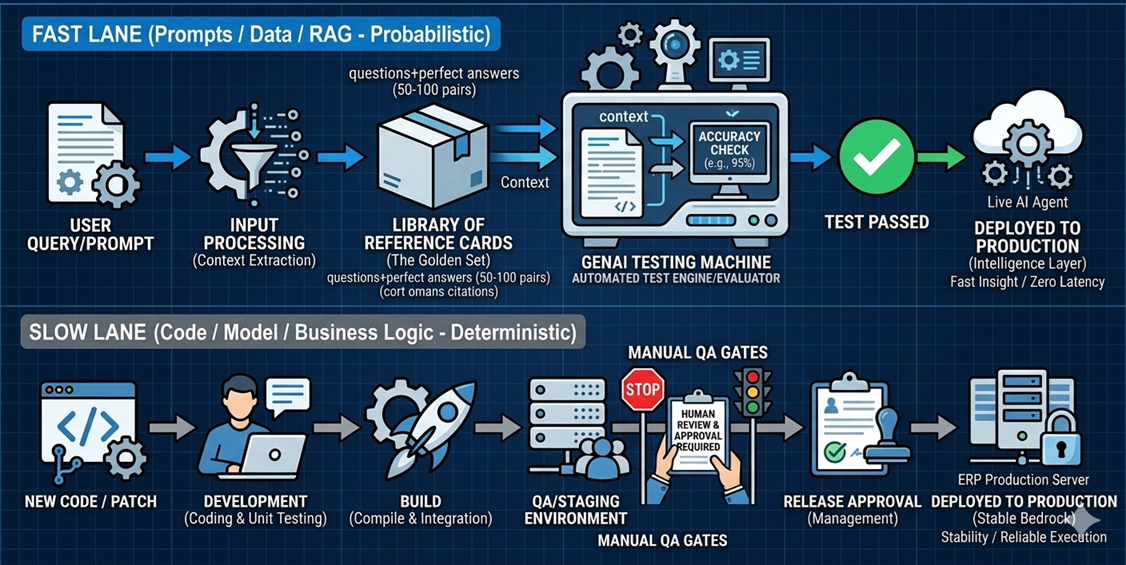
Traditional software Change Management utilizes a linear progression: Development → QA → Production. Code is written, tested for bugs, and deployed. This process is too slow and rigid for GenAI. Prompts, knowledge bases, and model parameters need to be adjusted frequently to combat drift.

The solution is a new validation methodology known as the “Golden Set.” Think of it like a standardized exam for your AI system. Just as a student’s knowledge is validated against a fixed set of correct answers before they are certified, every change to your AI system is validated against a fixed set of known-good responses before it is promoted to production. If the system “fails the exam,” the change is blocked.

The Golden Set Methodology

A “Golden Set” is a curated library of 50-100 “Question + Perfect Answer” pairs that define the expected behavior of the system.

  1. Reference: “What is the payment term for Vendor X?” -> “Net 30.”
  2. Evaluation: When a prompt is tweaked or a model is updated, the entire Golden Set is run automatically.
  3. Validation: The system compares the new answers against the “Perfect Answers.” If the accuracy drops below a defined threshold (e.g., 95%), the change is rejected.

This automated regression testing allows for a Two-Speed Change Process:

  • Fast Lane: Prompt engineers can update instructions and knowledge bases daily, relying on the Golden Set to catch regressions.
  • Slow Lane: Core code changes and architectural updates continue to follow the rigorous, slower SDLC process.

Conclusion: New Roles for a New Era

Operationalizing GenAI in the ERP requires more than new software; it requires new governance roles. The “AI Librarian” becomes essential for curating the knowledge base and ensuring data freshness. The “AI Auditor” is required to manage the Golden Sets and monitor for bias and drift.

The transition from “Day 1” (Implementation) to “Day 2” (Operations) is the moment the organization moves from unboxing a tool to mastering a discipline. The system will not sit still; the governance framework must be designed to steer it.

We at 1CloudHub have been helping enterprise customers to adopt GenAI as an augmented function to their ERP ecosystems, helping enterprises unlock tangible business and operational value. From identifying the right rollout strategies to implementing robust governance frameworks, we partner with organizations at every stage of the journey. Our approach goes beyond deployment — we embed the right processes, tools, and methodologies to combat drift, manage costs, and maintain alignment. Through structured knowledge transfer and hands-on training, we ensure that your teams are equipped to operate and evolve these solutions with confidence. The goal is not just a successful go-live, but a sustainably intelligent enterprise.

Navigating the Era of Abundance – Part 1: The Engine of Abundance (The “Zero Marginal Cost” Shift)

Introduction

We are standing at the beginning of a fundamental shift in how businesses operate and create value. For the past few years, the conversation around Generative AI has been dominated by awe at its capabilities—writing code, summarizing meetings, or generating marketing copy. But the true impact of GenAI is not just about what it can do; it is about what it does to the cost of doing it.

GenAI is driving the marginal cost of cognitive work—the cost to produce one additional unit of analysis, boilerplate code, or written content—close to zero. To understand this era of abundance, we have to look at the mechanisms driving this drastic fall in price of knowledge/cognitive work.

There are many debates happening around this topic and may experts have been sharing their thoughts around the future of workforce which will be a mix of human and digital that will be driving an era of abundance.

It triggered in me the curiosity to understand this and I embarked on doing research on the same, equipped with

  • My hypothesis
  • My Point of view from my knowledge of 3 decades of work experience
  • Loads of questions around the Impact of GenAI.

Obviously there is no one future model of economy that addresses all challenges but at least it gave me some idea on the challenges and the options we have at hand. I decided to share what I learnt through a series of blogs under the title “Navigating the Era of Abundance” and this is the first part in that series.

The Dematerialization of Expertise

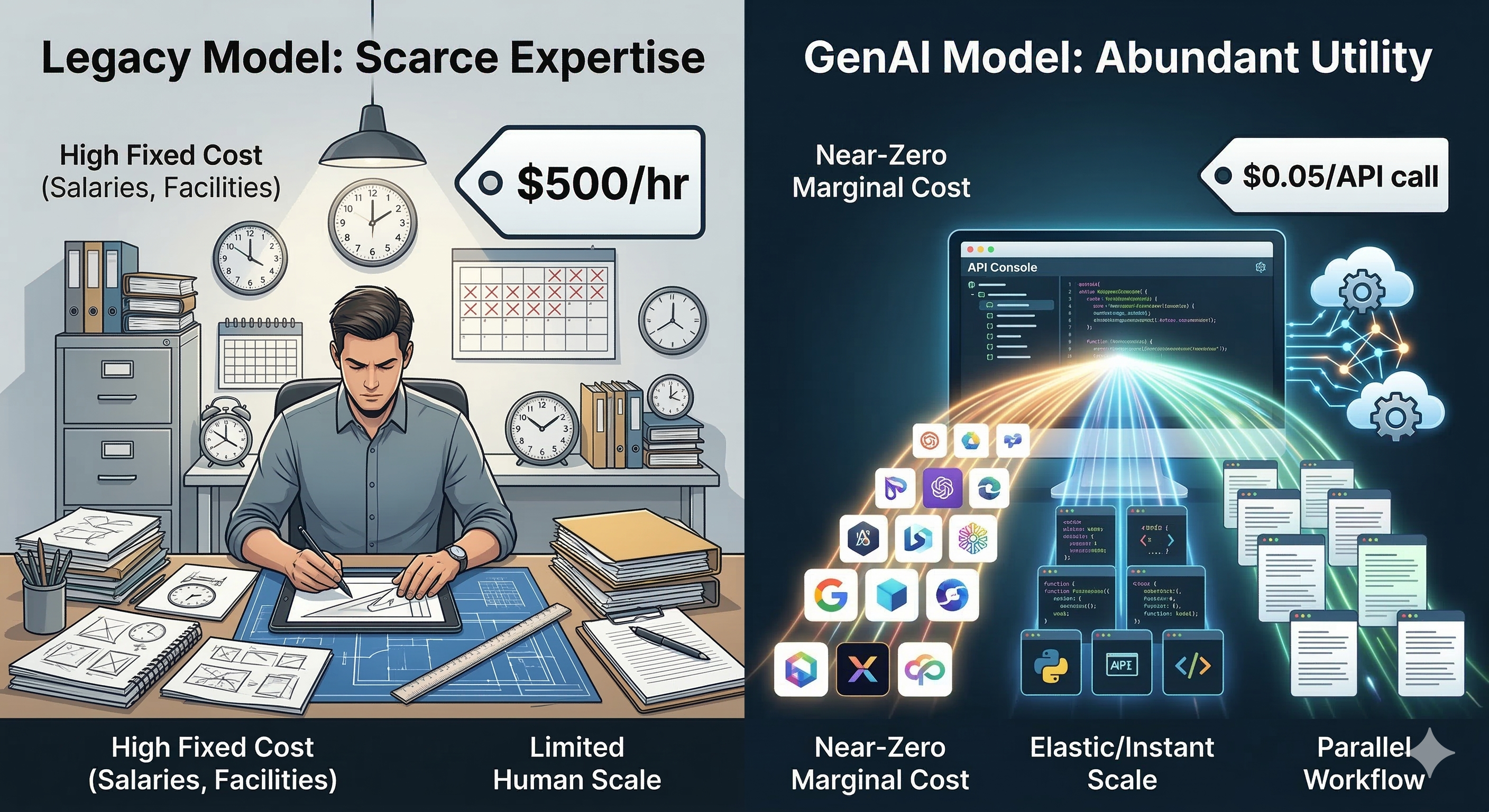
Historically, expertise was scarce, expensive, and bound by human physical limits. If an enterprise needed a complex compliance document reviewed or a foundational software module written, it had to make use of the services of a highly trained human brain by the hour.

GenAI takes that highly specialized expertise and “dematerializes” it ie. knowledge that used to be locked inside experts, tools, or long training cycles has been made accessible as a software that is lightweight, on‑demand and accessible instantly. It turns a bespoke service into a utility.

  • The Legacy Model: You pay a specialized consultant or developer for three days of work to draft standard operating procedures or build a basic data pipeline.
  • The GenAI Model: You pay fractions of a cent in compute power to generate a high-quality baseline draft or functional code structure in three seconds.

When the cost of generating high-quality cognitive output drops this drastically, it lowers the barrier to entry for innovation. Teams can experiment, build, and deploy at a velocity that was previously unaffordable.

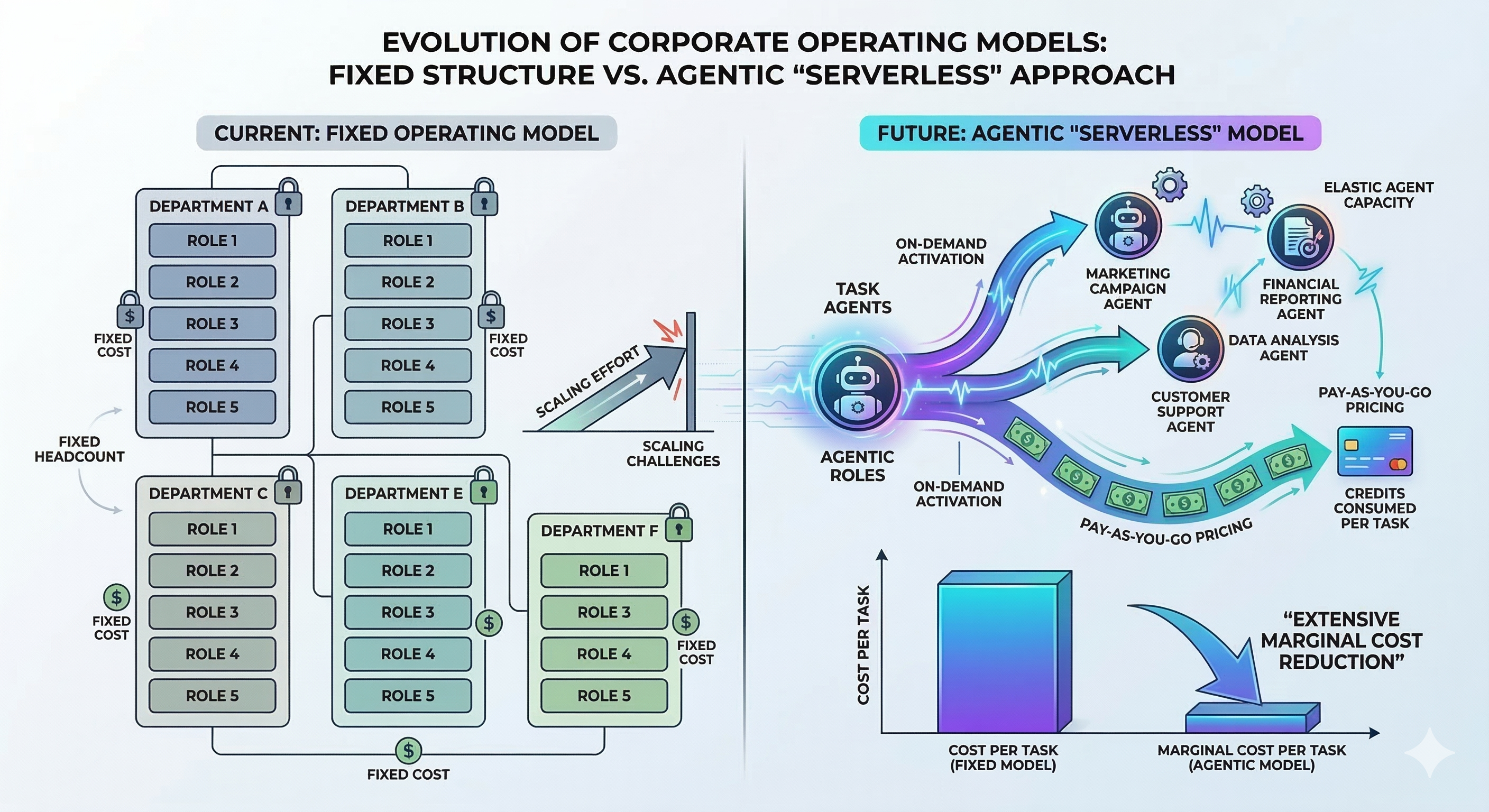
The “Serverless” Metaphor for Cognition

If you are familiar with enterprise IT, you know the massive shift that occurred when migrating from “On-Premise” data centers to the Cloud.

  • With traditional on-premise infrastructure, a company had to buy expensive physical servers to handle peak loads. Whether those servers were running at 100% capacity or sitting idle over the weekend, the enterprise paid the same massive fixed cost.
  • Cloud computing introduced the On Demand and Serverless model. Companies stopped paying for idle hardware and began paying only for the exact milliseconds of compute they actually consumed.

You can think of GenAI doing exactly this to human cognition in the context of corporate operating model. Right now, much of the corporate world operates on “On-Premise Cognition”. Companies maintain large teams to handle baseline operational tasks. They pay a fixed cost (salaries, benefits, office space) regardless of whether those teams are actively solving complex strategic problems or just formatting weekly status reports.

GenAI introduces “Serverless Cognition.” Instead of carrying a heavy fixed cost for routine, repetitive tasks, companies can call upon an AI agent to execute a workflow—such as translating legacy code, QA testing, or analyzing a spreadsheet—and they only pay for the API call. This elasticity allows an organization to scale its intellectual output up or down instantly, radically lowering the baseline cost of running a business.

Where Abundance Hits First

This economic shift may not happen everywhere all at once. It may start with transforming “bits” (digital goods) post which slowly transform other areas including transforming the “atoms” (physical space). We can already see a first wave of cost deflation happening in digital-first environments today:

  • Software Engineering: The generation of boilerplate code, unit tests, and routine debugging is becoming near-free. This does not replace engineers; it acts as a massive multiplier. A small, focused team can now output the volume of a traditional enterprise-scale engineering department.
  • First-Line Knowledge Work: Routine data synthesis—like summarizing customer calls, pulling insights from massive HR databases, or categorizing IT support tickets—is shifting from a human bottleneck to an instant, automated background process.
  • Digital Media & Communications: The cost to produce highly personalized text, training materials, and internal communications is plummeting, allowing organizations to provide tailored information at scale.

The engine of abundance is ultimately about unblocking bottlenecks that can help use cognition and knowledge for better use. When the cost to draft, code, and synthesize approaches zero, teams are freed from administrative drag, allowing them to focus entirely on strategy, architecture, and high-level problem solving.

Understanding How AI Thinks (and Where It Doesn’t) — Part 2 From Reasoning to Cognition

Introduction: What Was Missing

Quick recap (from Part 1): We saw that LLMs are very good at understanding meaning (semantics) and even reasoning step‑by‑step, but they still don’t decide or act on their own.

With that context in mind, this part continues the story by asking the next natural question: if understanding and reasoning aren’t enough, what actually enables intelligent behavior?

In Part 1, I shared understanding and reasoning alone do not decide or act. That realization naturally raised a follow-up question — if reasoning isn’t enough, what actually enables intelligent behavior?

In this post I wanted to share about what I learnt about the missing layer: cognitive capability, and how AI agents introduce it through architecture rather than model intelligence.

Cognitive Capability (Knowing What to Do Next)

This question brought me to the concept of cognitive capability — in simple terms, the ability of a system to decide and act, not just explain or understand.

Unlike semantic understanding or reasoning, cognitive capability is not about explaining information — it is about using information.

In simple terms:

It answers the question: “What should I do with this information?”

Cognitive capability includes:

  • Setting goals
  • Making decisions
  • Taking actions
  • Learning from results

Humans do this seamlessly, often without realizing it.

AI systems, however, do not gain this capability just by becoming better at language or reasoning. They require a different kind of design.

This distinction made the gap between humans and AI much clearer — and it naturally pointed to the concept of agents as the missing architectural layer.

AI Agents (Adding a Brain Around the Model)

Once cognition became the focus, AI agents entered the picture naturally. At this point in my thinking, agents stopped feeling like a buzzword and started feeling like a design necessity.

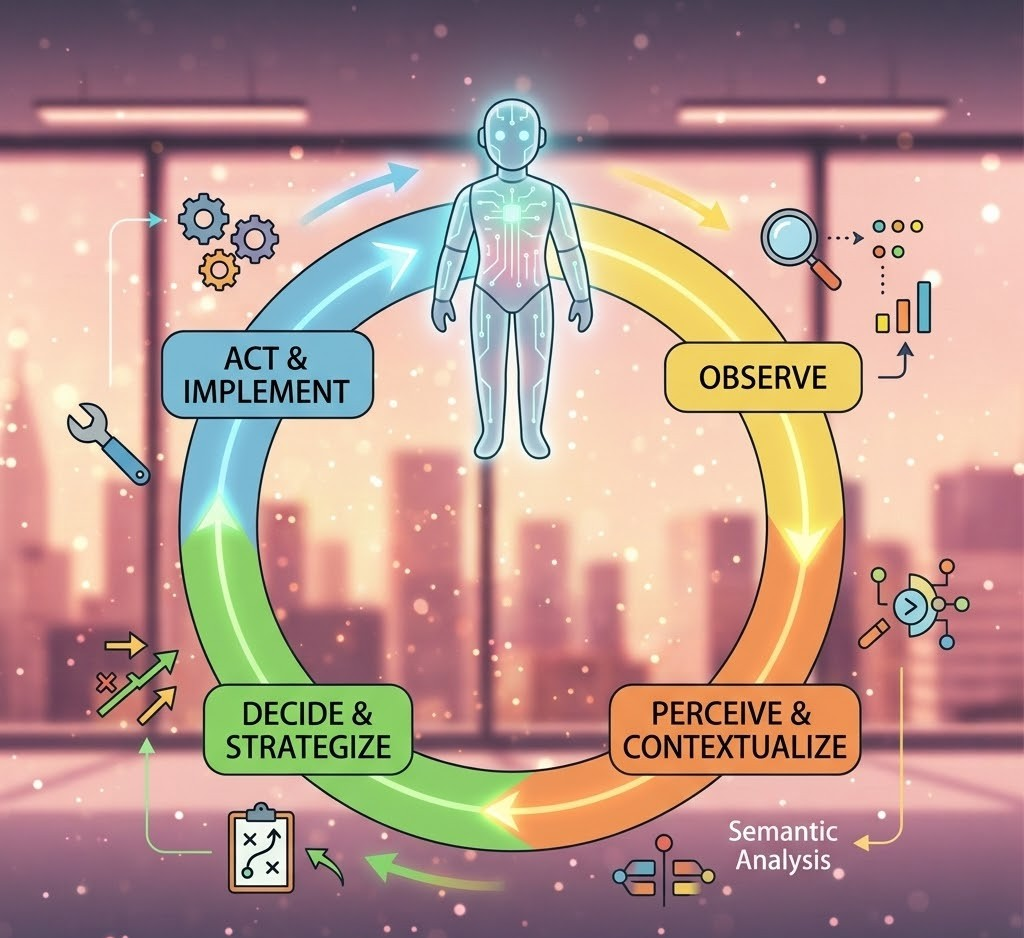
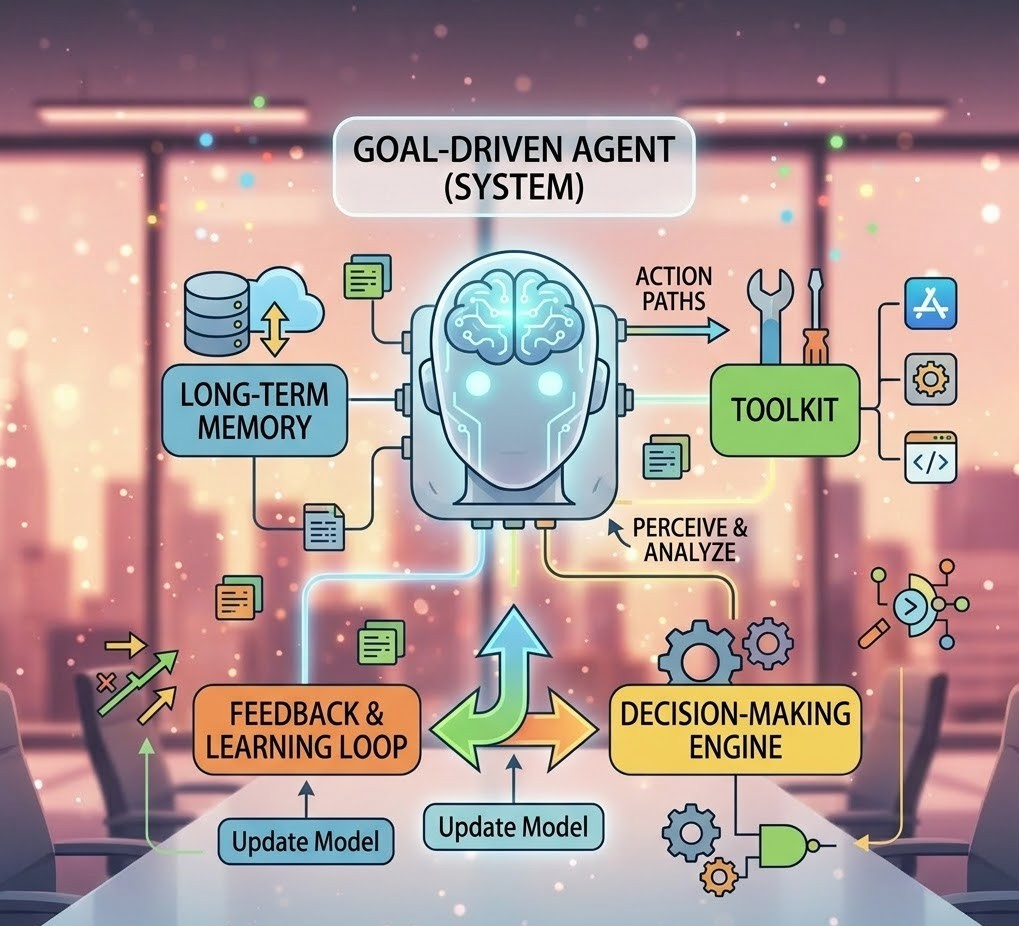
An AI agent is not just a smarter model — it is a system where a model is embedded inside a control loop.

That loop:

  1. Observes information
  2. Decides what to do
  3. Takes action using tools or systems
  4. Checks the outcome
  5. Adjusts its next step

In this arrangement, roles become clear:

  • The LLM understands language
  • The agent owns decisions and actions

This is when I was able to realized the importance of various concepts I kept reading and hearing through podcasts played an important role in building full AI system. I was able to understand why adding tools, memory, and feedback suddenly makes AI systems feel more capable, not because the model changed, but because cognition was introduced at the system level.

With this in mind, I again started wondering how closely this maps to human thinking — and whether humans use a similar separation between fast understanding and deliberate control.

System 1 and System 2 (How Humans Think)

To make sense of this comparison, it helped to borrow a well-known model from psychology that explains how humans think at different speeds.

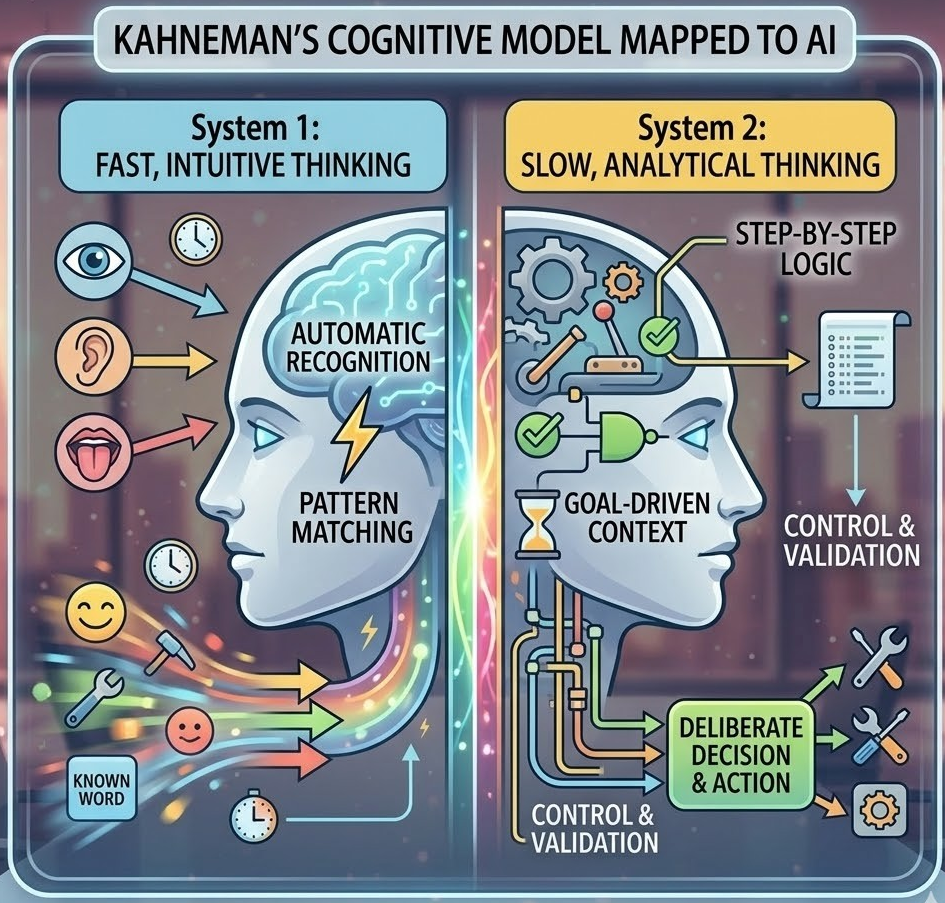
Psychologist Daniel Kahneman described two ways humans think:

System 1 – Fast Thinking

  • Automatic
  • Intuitive
  • Pattern-based

Example: Instantly recognizing a familiar face.

System 2 – Slow Thinking

  • Deliberate
  • Logical
  • Effortful

Example: Carefully solving a math problem.

Mapping This to AI

  • LLMs behave like System 1 — fast, fluent, intuitive
  • Agents behave like System 2 — slow, deliberate, controlling decisions and actions

This mapping helped me clarify why agents feel qualitatively different from standalone models — they introduce control, not just intelligence. That control is what allows systems to pause, decide, and act intentionally.

Conclusion: In AI Systems Cognition Is Architectural

Bringing these ideas together helped solidify the story so far: better models improve understanding, but better architecture enables cognition.

This part reinforced a key insight for me: cognition does not emerge automatically from better reasoning. It emerges from architecture — from systems that can observe, decide, act, and learn.

In the final part, I will share my understanding around why humans still outperform AI in ambiguity, where agents fall short of human cognition, and why this does not diminish the value of today’s AI systems.

Author’s Note: AI-assisted writing tools were used to support the creation of this post. All concepts, perspectives, and the underlying thought process originate from me; the AI served only as a drafting and refinement aid.

The ERP Awakening: Surviving Day 1: The Truth of GenAI Implementation

Introduction: From Vision to Reality

In Post 1: The ERP Awakening, the journey started with the promise of moving from static records to actionable intelligence. That vision is inspiring, but the real test comes on Day 1—when the system meets the real world. This post explores what it takes to move from vision to execution, focusing on the practical data challenges and the first steps in implementing GenAI in an enterprise context.

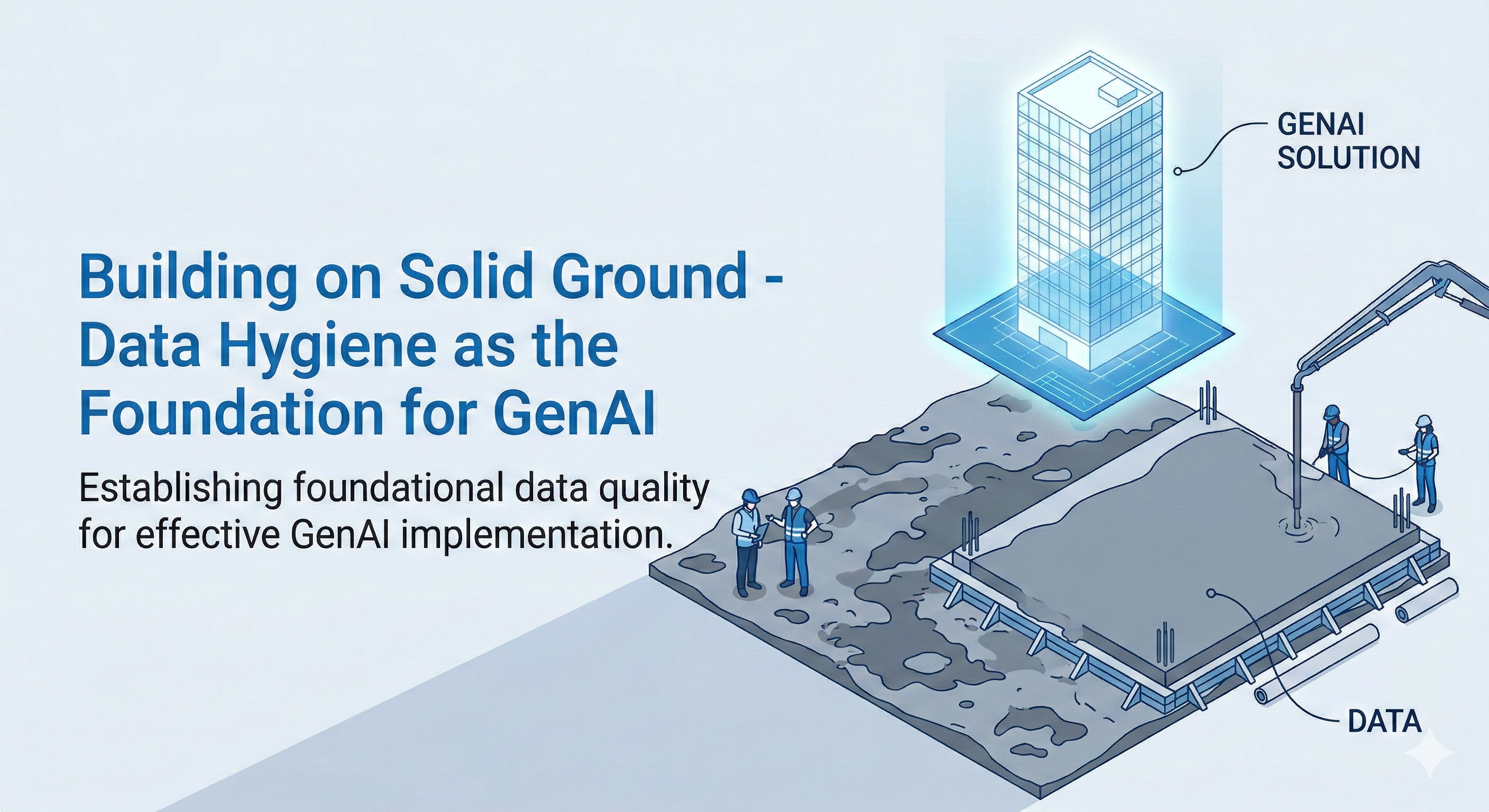
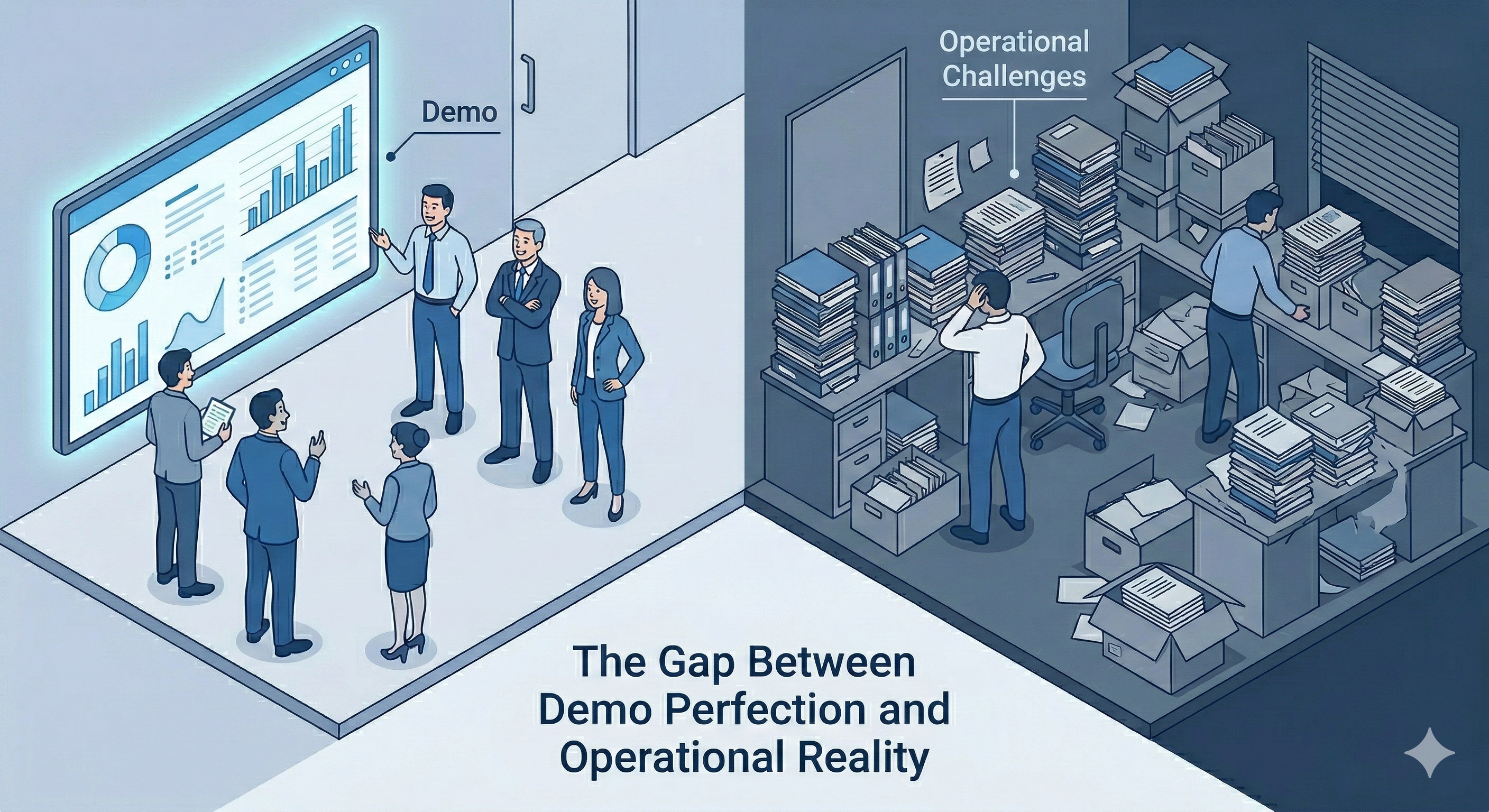
Context: The Demo Room vs. The Real World

The journey often starts in a demo room. The screen glows, the answers are instant, and the optimism is contagious. This is “Day 0”—the promise of transformation. But the real world is not a demo. When the system is switched on for actual business, the cracks start to show. Data is scattered, processes are inconsistent, and the system struggles to deliver the same clarity seen in the demo. The real work begins here, where vision meets reality.

Problem: Why Day 1 Hurts—The Data Challenge

Most business systems were built to keep records, not to explain them. Over the years, notes piled up, customer names got duplicated, and old process documents stuck around. When GenAI is introduced, it tries to make sense of all this information. The result can be confusion: the system might give an answer that sounds right but is built on mismatched records or outdated information. The real problem isn’t just “messy” data—it’s that the data was never organized for analysis and learning.

Root Cause: Data Standardization and Readiness for GenAI

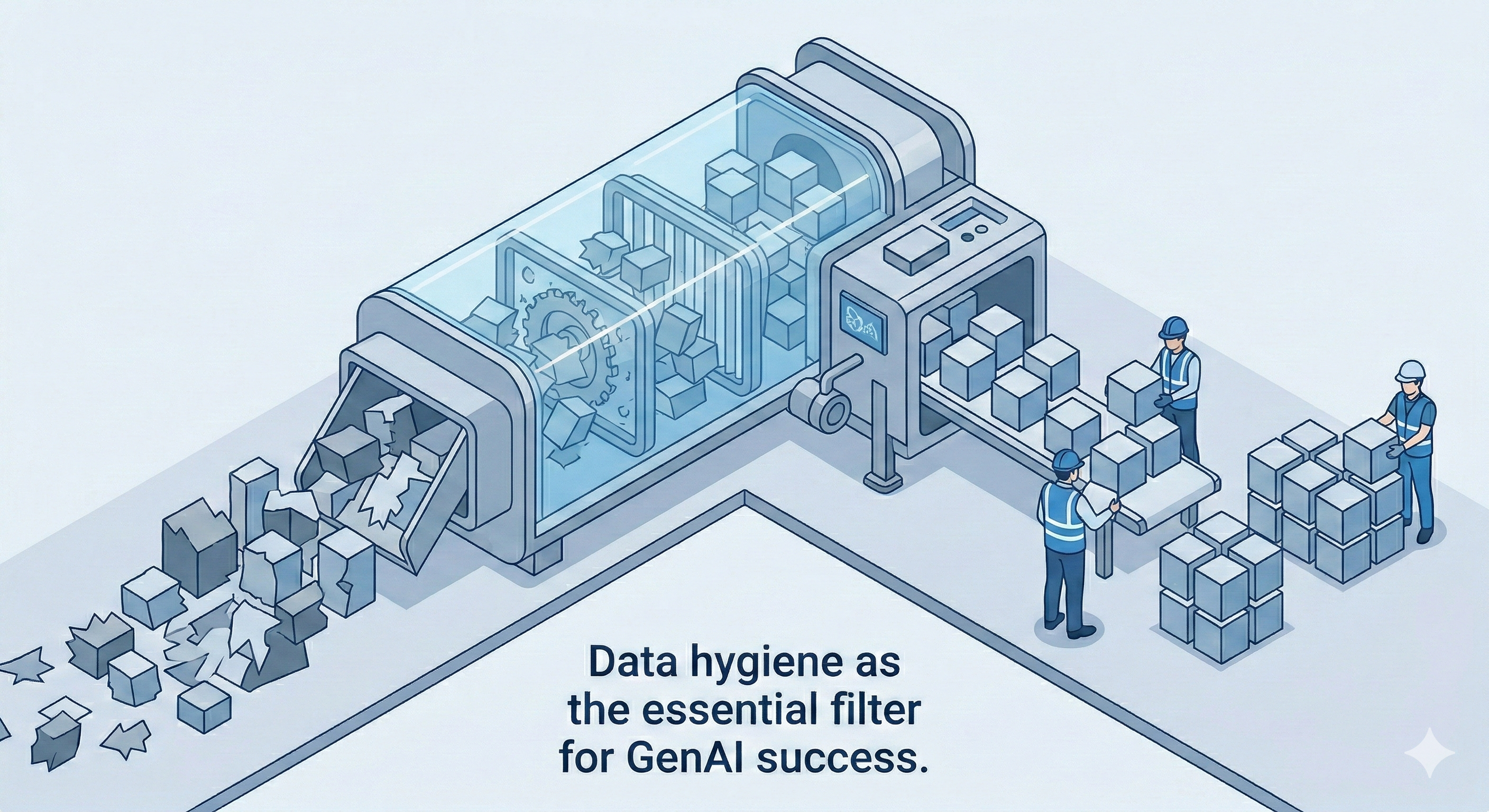
To get real answers, the data must be organized and standardized. This means:

  • Merging duplicate records (e.g., “Acme Corp” and “Acme Corporation” become one)
  • Retiring old process documents that no longer apply
  • Making sure important details aren’t buried in free-text notes or scattered emails

If these basics are skipped, GenAI will only repeat the confusion. Standardizing and aligning information is the first real step toward clarity and reliable automation.

Insight: What GenAI Actually Does with Enterprise Data

GenAI does not fix data inconsistencies; it surfaces and reflects them. When data is fragmented or non-standardized, GenAI will generate outputs that mirror these limitations. The system is only as good as the information it can access and understand. For GenAI to provide useful insights, the underlying data must be structured, current, and accessible.

Solution: Practical Approaches to GenAI Implementation

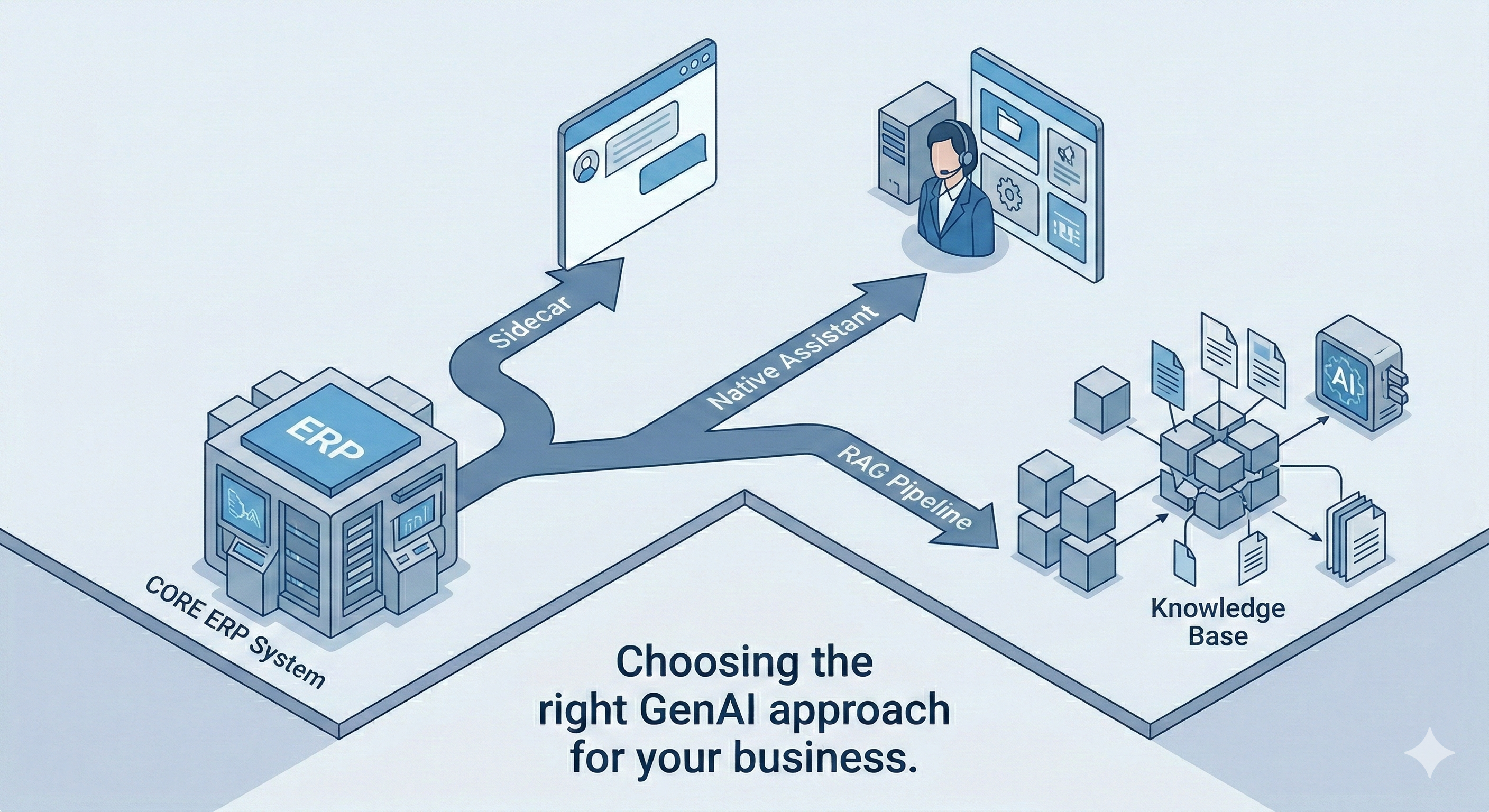
There are three practical ways to start implementing GenAI in an enterprise, each matching a stage of maturity:

Stage 1: The Chat Window (Sidecar)

  • What it is: A simple chat box that sits on top of the system, letting users ask questions about business data. It is best for getting started quickly, answering simple questions, and testing the waters.
  • Limits: Can only access surface-level information—no deep dives into complex business logic or historical context.

Stage 2: The Built-in Assistant (Platform Native)

  • What it is: GenAI features built into the ERP platform, with access to more business context and data relationships. Answers are richer and more connected to the business.
  • Best for: Organizations ready to move beyond basics, using the system’s built-in tools for deeper insights.
  • Limits: Follows the platform’s rules—custom requests or unique business logic may be out of reach.

Stage 3: The Custom Knowledge Layer (RAG Pipeline)

  • What it is: A custom solution that connects GenAI to all business data, documents, and records, enabling complex questions and advanced use cases.
  • Best for: Enterprises with unique needs, lots of documents, or special business rules.
  • Limits: Building and maintaining this solution takes time, effort, and ongoing care.

Implications: Trust, Transparency, and Change Management

No matter which approach is chosen, trust is built by showing the work. Every answer should come with a source or reference. If the answer isn’t certain, the system should say so. And for important decisions, a human should always have the final say. GenAI works best when everyone can see how the answer was found and understands its limitations.

Conclusion: Day 1 is Just the Beginning

Moving from vision to reality is not a one-day project. The first step is organizing and standardizing the data, then choosing the right approach for GenAI, and finally connecting all the necessary information. The journey is about making the system work for the business—clear, transparent, and ready for the next question. Along the way, each step introduces new concepts and practical learning about how GenAI can be implemented and trusted in the enterprise.

How We Help Enterprises @ 1CloudHub

At 1CloudHub, we help enterprises in adopting GenAI to transform ERP platforms into Systems of Intelligence. We help enterprises to navigate the journey from demo room optimism to Day 1 reality. We work with you to assess your data readiness, choose the right GenAI approach for your business, and build the governance frameworks that turn experimental pilots into sustainable competitive advantages. Whether you need to assess data readiness, platform selection, or a custom RAG solution, we’ve guided organizations through each phase to unlock real value from GenAI in their ERP environments.

Author’s Note: AI-assisted writing tools were used to support the creation of this post. All concepts, perspectives, and the underlying thought process originate from me; the AI served only as a drafting and refinement aid

The Applied AI Thoughts for Realization Blog Post 3

The Impact Layers — Why AI Models Alone Don’t Deliver Value

Introduction

This is the third post in the Applied AI Thoughts for Realization series.

In the first post, Why AI Feels Overwhelming, we tackled the problem of “AI Fatigue” and the trap of Tactical Thinking—chasing the latest tools without a plan. We argued for a shift to Structural Thinking, focusing on the architecture of problems rather than just the features of models.

In the second post, A Simple Mental Model — 4 Pillars, we established the horizontal dimension of our mental model. We categorized the AI landscape into 4 Domain Pillars—Consumer, Enterprise, Science, and Physical AI—and used the “Engine vs. Vehicle” analogy to show why a “Sports Car” strategy (Consumer) fails when you need a “Cargo Train” solution (Enterprise).

With the understanding of the 4 Pillars of different AI ecosystem and how the application of AI varies across the pillars its critical to understand what is required to deliver value in ech of the pillars. This brings us to the vertical dimension of our framework: The Impact Layers which play critical role in delivering value for each pillar.

Why a Model is not Everything in a AI Solution?

There is often a disconnect when we try to adopt AI. On one hand, we see headlines about models acing exams and writing code. It makes us feel model is what you need to role out a AI driven solution. On the other hand, when Enterprises or Consumers try to start deploying AI based solutions, they end up realizing its much more than just having a model. Enterprises have to address multiple challenges since they face multiple challenges like:

  1. The solution is not responsive and impacts user experience.
  2. Does not produce consistent or reliable results.
  3. It’s not quite fast enough, or it produces results that need a second look.
  4. Integration with existing systems is complex and time-consuming.
  5. The cost of running the solution at scale becomes prohibitively expensive.
  6. It works in demos but fails on real-world, messy data.
  7. Users don’t trust the output enough to act on it without verification.
  8. Models occasionally “hallucinate” or make confident errors.

The question then arises Why is there such a gap between the Intelligence we hear and read about around the Model and realizing the actual Capability we like to experience?

The answer lies in understanding that a “Model” is not the final “Product” or “Solution”.

A model is just raw potential—like a powerful engine sitting on a factory floor. To turn that potential into actual value, it is dependent on several layers of translation. It needs to be hosted on hardware, connected to tools, wrapped in an interface, and integrated into a workflow.

If any one of those layers is weak, the entire experience fails.

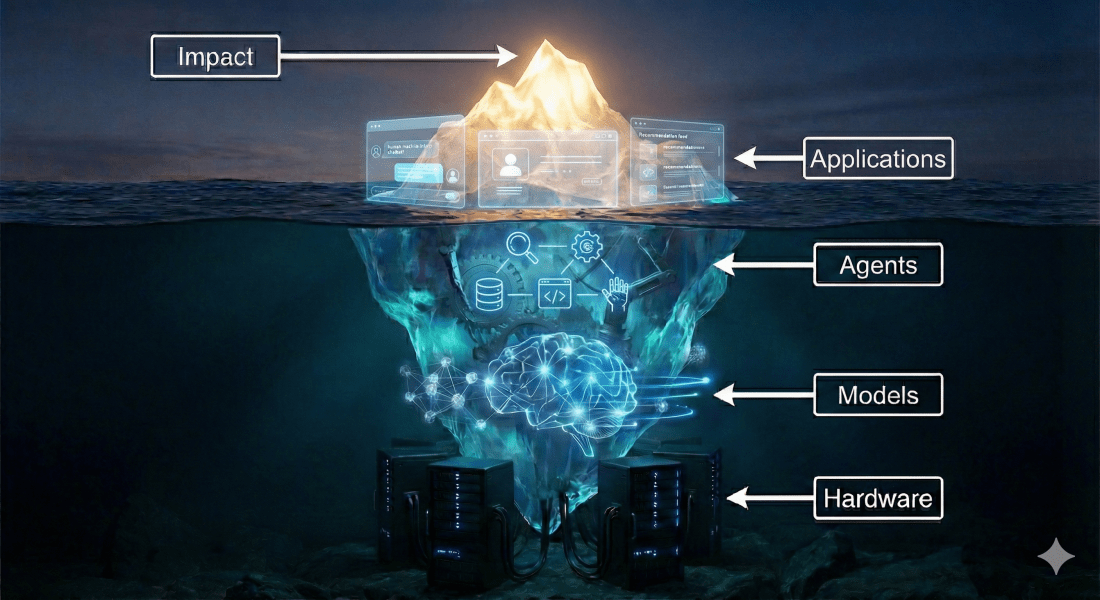
The “Iceberg” Theory of AI

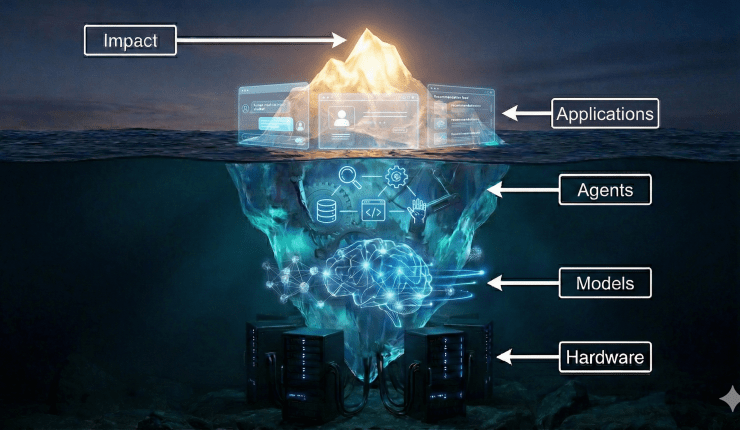
A helpful way to visualize this is the Iceberg Theory of AI.

When you interact with an AI application—whether it’s a chatbot, a recommendation engine, or a robot—you are only seeing the tip of the iceberg.

  • Above the Water (Visible): The Application Layer. This is the user interface, the buttons, and the response time. This is what we judge.
  • Below the Water (Invisible): The massive infrastructure that supports that tip. This includes the Agents (logic), the Models (intelligence), and the Hardware (compute).

Most of the hype focuses on the “Model” layer deep underwater. But most of the failure happens in the layers between the model and the user. To understand why an AI project succeeds or fails, we need to look below the surface and examine the 5 Layers of AI Impact.

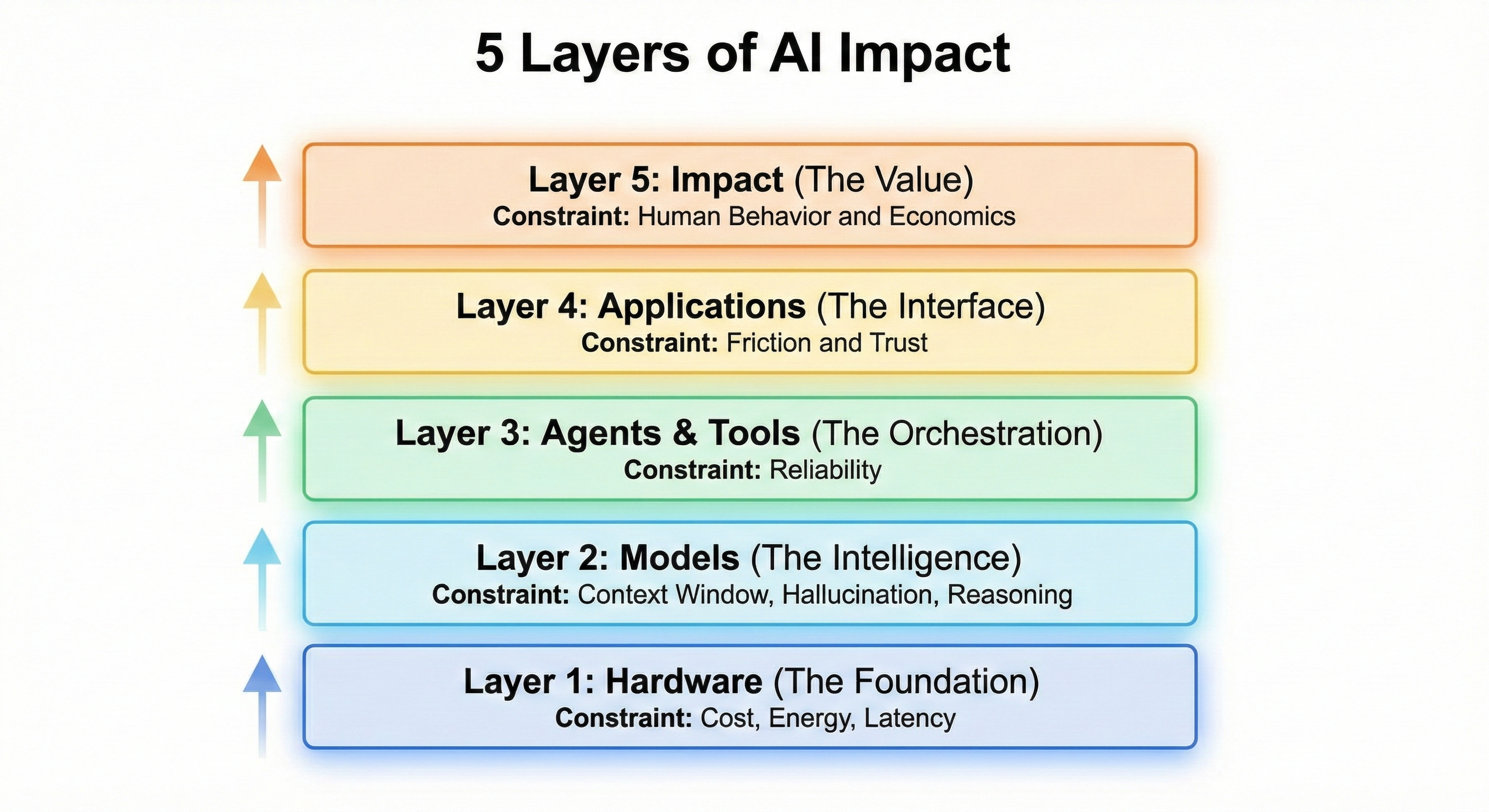
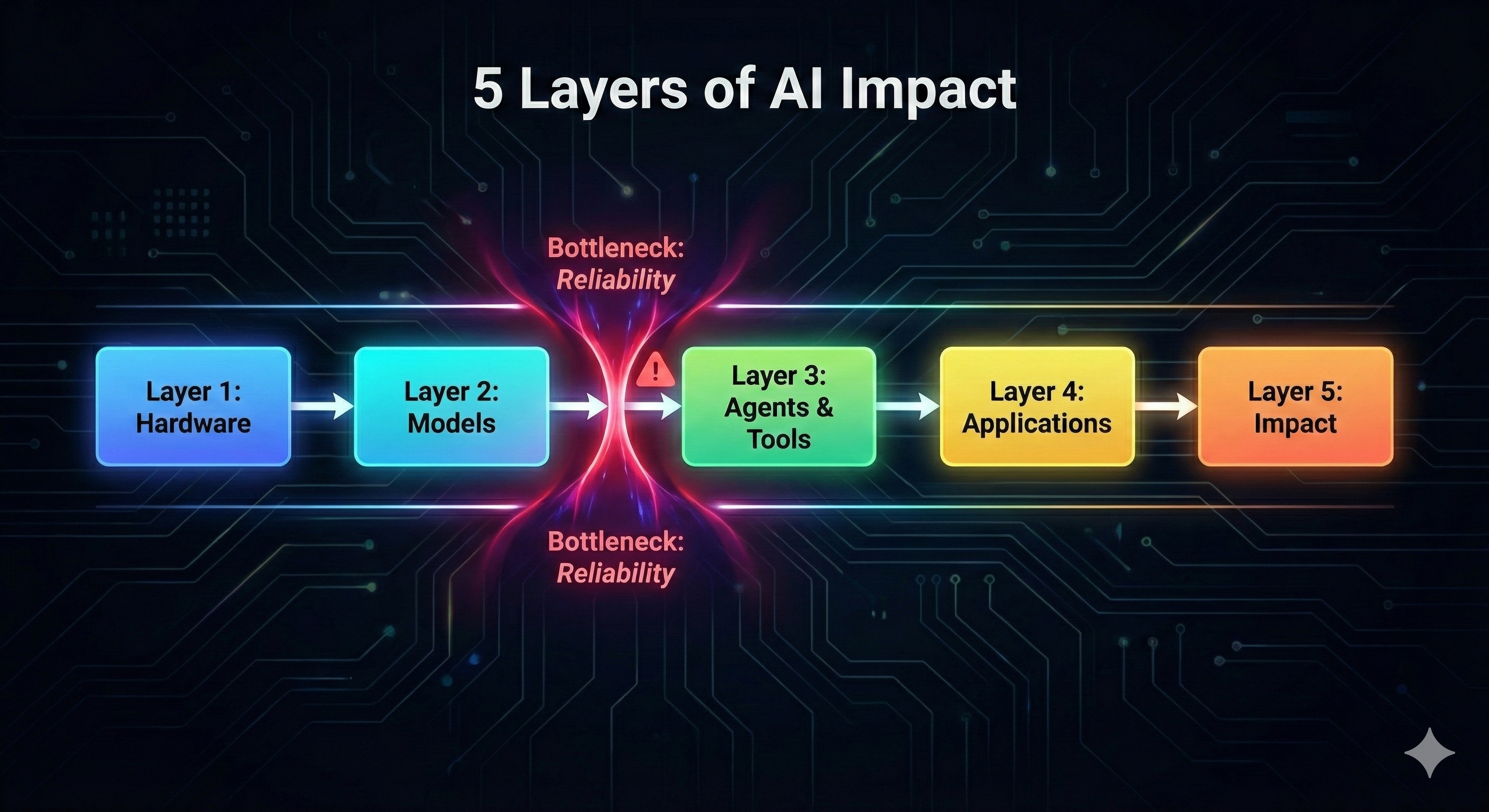
The 5 Layers of AI Impact

Progress in AI doesn’t happen all at once. It moves up this stack, layer by layer.

Layer 1: Hardware (The Foundation)

This is the physical reality of AI. It includes the GPUs (chips) that train models, the data centers that host them, and the edge devices (phones, robots) that run them.

  • Why it matters: Hardware dictates feasibility. You might have a brilliant AI model, but if it requires $10,000 of compute per hour to run, it cannot be a consumer product. If it takes 5 seconds to respond, it cannot be a self-driving car.
  • The Constraint: Cost, Energy, and Latency.

Layer 2: Models (The Intelligence)

This is what we typically call “AI.” It includes Large Language Models (LLMs), diffusion models (images), and predictive models. This layer provides the raw reasoning and pattern-matching capability.

  • Why it matters: Models dictate potential. A smarter model can solve harder problems.
  • The Constraint: Context Window (memory), Hallucination (accuracy), and Reasoning capability.

Layer 3: Agents & Tools (The Orchestration)

This is the bridge between thought and action. A model can only output text; an Agent can use that text to call a tool—like searching the web, querying a database, or clicking a button.

  • Why it matters: Agents dictate utility. Without this layer, AI is just a chatbot. With this layer, AI becomes a coworker that can book flights, write code to disk, or control a robot arm.
  • The Constraint: Reliability. If an agent gets confused and clicks the wrong button, it causes chaos.

Layer 4: Applications (The Interface)

This is the software layer where the human meets the machine. It includes the UI/UX, the workflow integration, and the “vibe” of the product.

  • Why it matters: Applications dictate adoption. A powerful agent wrapped in a confusing interface will be ignored. The best AI applications often hide the AI completely (e.g., Netflix recommendations).
  • The Constraint: Friction and Trust. Users must feel in control.

Layer 5: Impact (The Value)

This is the final result. It is not software; it is the change in the real world. Does this tool save time? Does it cure a disease? Does it increase revenue?

  • Why it matters: Impact dictates sustainability. If an AI project doesn’t generate real value (ROI or societal good), it will eventually be shut down, no matter how cool the technology is.
  • The Constraint: Human Behavior and Economics. Just because a tool exists doesn’t mean people will change their habits to use it.

The Bottleneck Theory: Why Progress is Non-Linear

The most important thing to understand about these layers is that they must work in coherence.

We cannot simply “upgrade” one layer and expect the whole system to improve. In fact, the system is always limited by its weakest link.

  • Historical Example: In the 1960s, AT&T invented the Picturephone. It was a brilliant Layer 4 (Application) idea. But Layer 1 (Network Bandwidth) wasn’t ready. The product failed spectacularly.
  • Current Example: Today, we have incredible Layer 3 (Agent) concepts—AI employees that can do everything. But often, Layer 2 (Model Reliability) isn’t quite there yet; the models still hallucinate occasionally. As a result, the “AI Employee” fails to be reliable enough for critical work.

This interdependence creates a “hurdle for adoption.” You might have the budget and the desire, but if one layer in the stack is immature, your project will stall.

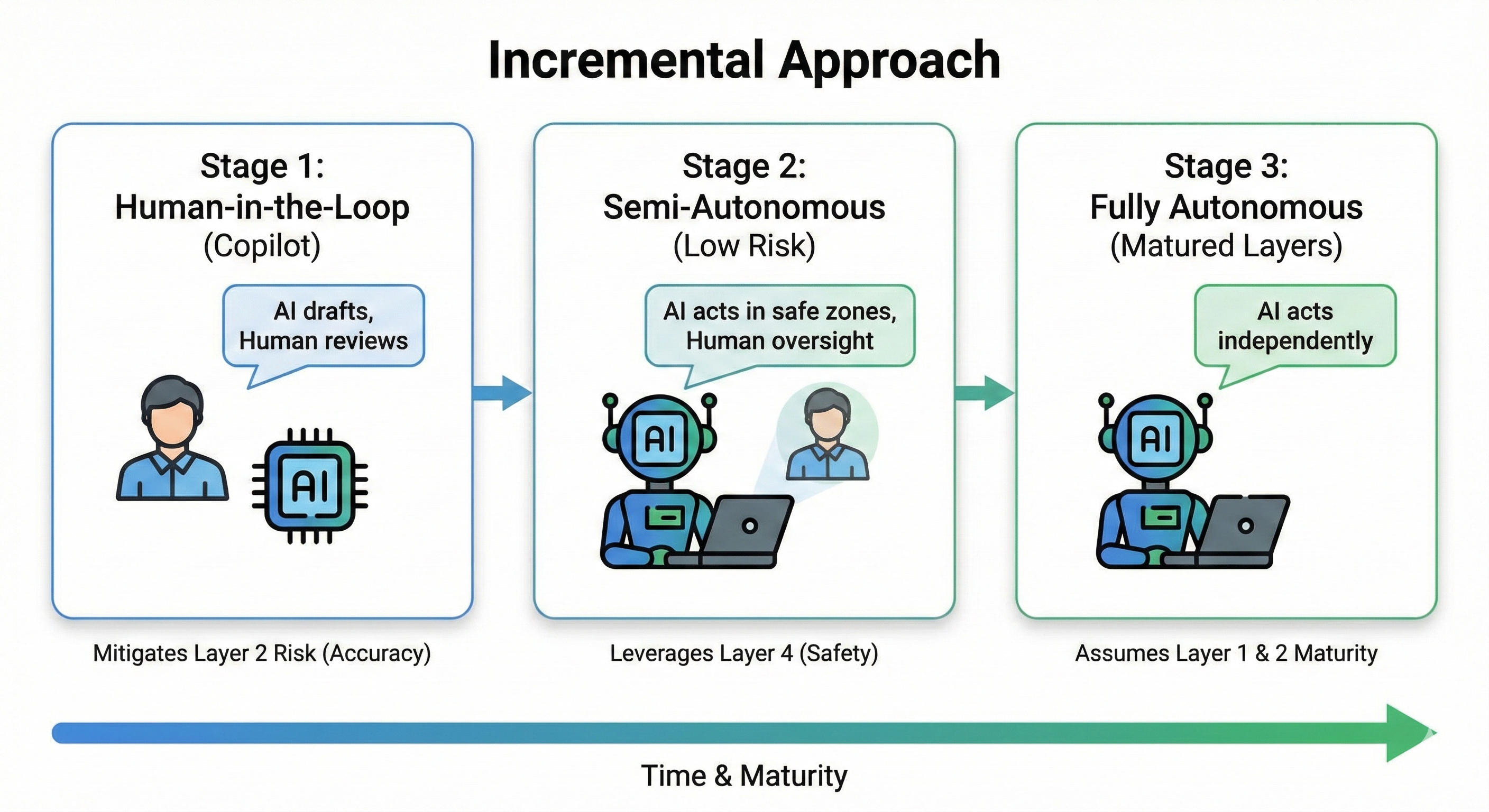
Guidance: The Incremental Approach

So, how do you build when the stack isn’t perfect? You adopt an Incremental Approach.

Instead of trying to build the “Ultimate AI System” that relies on every layer being perfect, you build for the layers that are ready today.

A sample scenario how to Approach incremental Build:

  1. Start with “Human-in-the-Loop” (Layer 3 Lite): Don’t try to build fully autonomous agents yet. Build “Copilots” where the AI drafts the work, and a human reviews it. This mitigates the Layer 2 (Accuracy) risk.
  2. Focus on “Low-Risk” Applications (Layer 4 Safety): Deploy AI in internal brainstorming or draft generation before putting it in front of customers.
  3. Scale as Layers Mature: As models get cheaper (Layer 1 improves) and smarter (Layer 2 improves), you gradually remove the human guardrails.

Advantages:

  • Immediate Value: You get ROI now, rather than waiting 5 years for “AGI.”
  • Learning: Your organization learns how to work with AI data and workflows.
  • Safety: You avoid catastrophic failures by keeping humans involved.

Disadvantages:

  • Maintenance: You have to constantly update your system as the underlying layers change.
  • Process Change: It requires changing how people work (training them to use Copilots), which is often harder than just installing software.

By respecting the bottleneck, you build systems that actually work, rather than science fiction that breaks on day one.

Summary

In this post, we explored the vertical dimension of AI execution: the 5 Layers of Impact. We saw how a seemingly simple AI application is actually supported by a complex stack of Hardware, Models, Agents, and Interfaces, and why the “weakest link” in this chain often determines success. But understanding the pillars and layers is only half the picture. In the next post, “How Pillars and Layers Work Together,” we will merge the horizontal Pillars and vertical Layers into a unified perspective. This approach will allow you to predict the behavior, timeline, and constraints of any AI project by understanding how technical layers interact differently across each distinct domain pillars.

Author’s Note: AI-assisted writing tools were used to support the creation of this post. All concepts, perspectives, and the underlying thought process originate from me; the AI served only as a drafting and refinement aid

Previous Post : The Applied AI Thoughts for Realization Blog Post 2

Understanding How AI Thinks (and Where It Doesn’t) – Part 1 Are LLMs Really Understanding?

From a DeepSeek Article to trying to Understand Semantics vs Reasoning Cognitive concepts in AI


Introduction:

This first part captures the beginning of my thought journey. What started as reading an article about DeepSeek’s long-text technique slowly turned into a more fundamental question about what we really mean when we say an AI system “understands.”

A Simple Article That Led to a Big Question

I recently read an article about a research study that questioned a technique used by DeepSeek to help AI models read very long texts. The idea sounded impressive: compress large amounts of text so an AI can process more information at once.

But the researchers found something surprising.

The AI seemed to perform well not because it truly understood the text, but because it relied on patterns it had seen before. When those patterns were disrupted, the model struggled badly.

Even though I already had a working understanding of how LLMs work and Transformer architectures function, something about this finding triggered my interest to learn deeper. If these models were struggling the moment patterns broke down, what exactly were they doing when we say they “understand” text?

This thought triggered a deeper line of questioning in my mind — not about DeepSeek specifically, but about how we interpret progress in GenAI as a whole.

That curiosity naturally led me to ask:

Are modern AI systems really understanding, or are they just very good at guessing?

Once that question formed, it became clear that I needed to first separate two ideas that are often mixed together: semantic understanding and cognitive capability.

Semantic Understanding (Knowing What Something Means)

The first concept I needed clarity on was semantic understanding — a term frequently used but rarely unpacked.

Semantic understanding simply means understanding the meaning.

In everyday language:

It answers the question: “What does this mean?”

Large Language Models (LLMs) are exceptionally strong in this area.

They can:

  • Read a paragraph and explain it
  • Summarize documents
  • Translate languages
  • Recognize relationships between ideas

For instance, when an AI explains a legal document or summarizes a report, it is exercising semantic understanding. In many ways, this mirrors how humans comprehend words and sentences.

However, as I reflected on the DeepSeek article, an important limitation became obvious.

Semantic understanding stops at meaning.

It explains what is being said, but it does not decide what should happen next.

That realization naturally pushed me toward the next question: if understanding meaning is not enough, what role does reasoning actually play?

Reasoning Models (Thinking Better, Not Acting Better)

At this point, my attention shifted to reasoning models, often marketed as “thinking” AI.

These models are designed to show their work. They break problems into steps, apply logic, and produce more structured explanations.

On the surface, this feels like a major leap forward — and in many ways, it is.

But when I looked more carefully, I noticed that reasoning models still revolve around a single question:

“What is the best response to this input?”

Even with better logic, they still do not:

  • Choose goals (which is critical for decision-making — without goals, outputs remain just well-organized facts)
  • Take responsibility for outcomes
  • Act independently in the world

So while reasoning models think better, they don’t actually decide.

This insight clarified something important for me: reasoning improves semantic structure, but it still operates within the same boundary.

That naturally led to the next question — if neither understanding nor reasoning decides action, then what does?

Part 1 Conclusion: A Boundary Becomes Visible

By the end of this first part, one boundary had become very clear to me.

Understanding meaning and reasoning about it — even in sophisticated ways — does not automatically lead to decision-making or action. Something else is required.

In the next part, I will share my learning about the missing layer: cognitive capability, and why AI agents represent an important architectural shift rather than just a smarter model.

The ERP Awakening: From System of Record to System of Intelligence

The Foundation of Stability

For the last 30 years, the enterprise software industry has focused on one massive engineering achievement: Stability.

Enterprises have implemented SAP, Oracle, and Microsoft Dynamics to serve as the bedrock of their operations. They optimized for the “System of Record”—an immutable, reliable vault where every transaction is stamped, stored, and secured. In this regard, the strategy succeeded. The foundation is solid.

The Challenge: Data Rich, Insight Constrained

However, a vault is designed to keep things in, not necessarily to let insights out.

Today, the modern ERP operates like a massive, well-organized reference library. It contains all the answers—”Why is margin down?”, “Which supplier is late?”—but finding them requires users to walk the aisles, pull specific files (T-Codes), and decode complex rows of data. This architecture creates three distinct layers of operational friction:

  1. The Insight Latency: Business leaders cannot ask questions directly. They often rely on technical intermediaries to build reports, leading to a “time-to-insight” gap of days or weeks.
  2. The Productivity Burden: Skilled professionals spend hours on high-volume, manual tasks—drafting standard emails, visually verifying invoices against purchase orders when there is an exception, or creating requisition forms.
  3. The Execution Variance: Critical workflows can experience delays due to minor “micro-stops”—like a pricing discrepancy of a few cents—that require manual human intervention to clear.

While the enterprise possesses the data, it often lacks the agility to act on it instantly.

Moving from System of Record to System of Intelligence

If the modern ERP is a comprehensive library, the operational bottleneck lies in the absence of a guide. Users are currently forced to act as their own researchers—navigating complex schemas and table structures just to retrieve basic facts.

Hence the strategic value of Generative AI lies not in replacing the library (the ERP), but in providing an intelligent Librarian to navigate it. By layering cognition over storage of records, enterprises can transition from a passive System of Record to an active System of Intelligence.

The “Three Stages” of Change

To make this transition actionable, organizations should view the evolution from a System of Record to a System of Intelligence not as a single leap, but as three distinct stages of maturity. Each stage builds trust and capability, moving from passive insight to active orchestration.

Stage 1: Synthesizing Intelligence (The Conversational Analyst)

  • Key Objective: To democratize access to complex ERP data, enabling “self-service” analytics without technical dependency.
  • Strategic Rationale: The primary bottleneck in most enterprises is “Insight Latency.” Business users face a barrier to entry—they do not know the technical schema required to query the ERP. The first step is to remove this friction by allowing natural language interrogation of the data.
  • Execution Strategy: Enterprises implement Text-to-SQL layers that act as a “universal translator.” Instead of navigating menus, users query the database using natural language. The system translates the intent into a precise SQL or OData query.
  • Tangible Impact:
    • Use Case: A Regional CFO needs to understand a sudden variance in APAC logistics costs. Instead of commissioning a BI report (3-day lag), they ask the system directly and receive a visual breakdown of freight surcharges in seconds.
    • Outcome: Zero time-to-insight for ad-hoc queries.

Stage 2: Augmenting Operations (The Generative Assistant)

  • Key Objective: To standardize communication and documentation while significantly increasing workforce velocity.
  • Strategic Rationale: Once users have insight, they must act on it. Often, this action involves creating content—emails, contracts, or summaries. This stage focuses on removing the “Blank Page” fatigue that drains high-value human talent on low-value drafting tasks.
  • Execution Strategy: This involves Content Generation thru Context Injection. The architecture feeds specific transaction data (such as open Purchase Orders or vendor contracts) into the LLM prompt, instructing it to draft content based on that specific reality for human review.
  • Tangible Impact:
    • Use Case: A procurement team needs to send dunning emails to 50 suppliers regarding late shipments. The Assistant auto-drafts 50 unique emails, each referencing the specific PO number, delay duration, and relevant penalty clauses from the master contract.
    • Outcome: Massive productivity gains and strict legal/policy compliance in external communications.

Stage 3: Autonomous Orchestration (The Process Agent)

  • Key Objective: To achieve “Zero-Touch” processing for routine variances, freeing human capital for complex problem-solving.
  • Strategic Rationale: Speed is often lost to minor details. Traditionally, any error—no matter how small—halts the process for human review. This stage shifts the paradigm to “Management by Exception,” where the system autonomously resolves routine problems, leaving only complex strategic decisions for human experts.
  • Execution Strategy: Deploying Agentic Automation. Autonomous agents are granted write-access to specific API endpoints and governed by strict policy logic (e.g., “If variance < $5, then approve”).
  • Tangible Impact:
    • Use Case: The Accounts Payable close is stalled by hundreds of “micro-variances” where invoice totals differ from POs by cents due to rounding errors. The Orchestrator scans, verifies the tolerance policy, and posts the clearing documents automatically.
    • Outcome: A faster financial close and a shift of human effort from data entry to strategic relationship management.

The Engineering Challenge: Building Trust

While this transition unlocks immense potential, it forces IT departments to confront a fundamentally new maintenance paradigm: the shift from managing deterministic code to governing probabilistic behaviors.

In traditional systems, if a report generates a wrong number, it is usually a bug in the code that can be traced, patched, and redeployed. In the era of AI, systems face Probabilistic outcomes. A model might generate a slightly different answer depending on context.

This requires new “safety rails”:

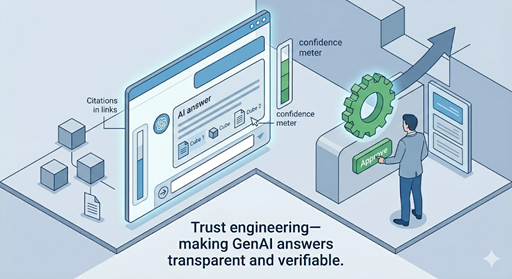
  • Glass Box UI: Systems must always show the user where the answer came from (citations).
  • Human-in-the-Loop: For high-stakes actions (like paying a vendor), the AI should draft the proposal, but a human must execute the final approval.

The Path Forward

The journey to a GenAI-augmented ERP is an architectural evolution, not a “rip-and-replace” project. To manage risk and ensure successful adoption, enterprises should align their implementation roadmap with the three-stage maturity model defined above.

By starting with Stage 1 (Insight), organizations can validate data accuracy and build user trust in a safe, read-only environment. Once confidence is established, they can advance to Stage 2 (Creation), introducing productivity gains while maintaining human oversight. Finally, only after proving stability, should they progress to Stage 3 (Action) for autonomous processing. This measured evolution ensures that capability grows alongside governance, minimizing operational risk while maximizing business value.

At 1CloudHub we are closely working with Enterprise customers to help them navigate the path to maturity through our consulting services and our solutions and products that help Enterprise to accelerate the pace of adoption to augment GenAI with ERP systems.

Coming Up – Navigating Day 1 Challenges

In the next post, the focus will shift to the foundation. Before building these intelligent layers, enterprises need to ensure their data is ready to support them. The discussion will cover practical strategies for Data Hygiene and how to start small with “Sidecar” pilots.

Author’s Note: AI-assisted writing tools were used to support the creation of this post. All concepts, perspectives, and the underlying thought process originate from me; the AI served only as a drafting and refinement aid

  • Coming Up: Post 2 – Navigating Day 1 Challenge : The Practical Reality of Implementation.

The Applied AI Thoughts for Realization Blog Post 2

A Simple Mental Model — How I Break the AI World into 4 Pillars

Introduction

In my previous post, I had shared about the need to shift from Tactical Thinking (chasing tools) to Structural Thinking (understanding the landscape) to understand the AI Landscape. In this post, we will build the foundation of that structure.

When we talk about “Applied AI,” it is easy to get fixated on the “AI” part—the models, the algorithms, the neural networks. But in the real world when we try to adopt AI, the model is often just one part of the equation.

Applied AI is not just about Models; it is a system.

To make AI work, you need more than just intelligence. You need data pipelines, user interfaces, safety guardrails, integration logic, and hardware infrastructure. You need to consider the human who uses it and the environment where it operates. When you look at the full picture, you realize that “AI” is just one ingredient in a complex recipe. And just like in cooking, the same ingredient (AI) produces a completely different result depending on what else you mix it with and how you serve it.

The Core Concept: Why “AI” Is Not One Thing

The biggest mistake organizations and individuals make is treating AI as a monolithic wave—assuming that the same rules, timelines, and strategies apply everywhere. They ask generic questions like “When will AI replace jobs?” or “Is AI safe?”

These questions do not have a simple straight forward answer because since adopting AI is not just focusing on one thing ie “AI”.

The Analogy: The Engine vs. The Vehicle

Consider an AI model (like GPT-4 or Claude) as a high-performance engine. An engine is a sophisticated core component, yet it provides no transportation utility on its own. To function effectively, it requires a chassis, wheels, a steering system, and an operator. It must be integrated into a complete vehicle.

Imagine attempting to solve every transportation challenge with a single strategy: “Install a high-performance sports car engine.”

  • On a racetrack (Consumer): This approach works perfectly; speed is the primary objective.
  • Plowing a field (Enterprise/Industrial): A high-revving engine is ineffective; the requirement is torque, traction, and sustained power under load.
  • Transporting cargo across an ocean (Logistics): Raw speed is irrelevant compared to fuel efficiency, durability, and massive scale.
  • Exploring the surface of Mars (Frontier/Science): A standard combustion engine will fail instantly due to environmental constraints; the need is for rugged autonomy and specialized engineering.

This is exactly how Applied AI works. The “Engine” (the intelligence) might be similar across different use cases, but the “Vehicle” (the application) must be radically different depending on the terrain. Some times even the Engine has to be modified for some use cases.

This principle applies directly when rolling out AI driven applications. Different applications require fundamentally different architectures, not just different features. Cotninuing with the vehicle anology below section talks about how we can map the 4 AI pillars to different vehicle type:

  • Consumer AI (The Sports Car): Optimized for high velocity, agility, and individual engagement. The priority is reducing user friction and maximizing experience.
  • Enterprise AI (The Freight Locomotive): Engineered for massive scale, unwavering reliability, and strict governance. The priority is secure, consistent throughput on defined rails.
  • Science AI (The Deep-Sea Submersible): Purpose-built for extreme precision in unexplored environments. The priority is navigating high-complexity domains to extract novel insights rather than speed.
  • Physical AI (The Industrial Rover): Designed for real-world interaction where the cost of failure is physical. The priority is safety, sensor integration, and navigating dynamic, unstructured environments.

If you try to apply “Sports Car” thinking to a “Cargo Train” problem, you will crash. This is why we need to break the AI landscape into 4 Pillars.

The 4 Pillars of Applied AI

Now that we have explored the vehicle analogy, it is clear why AI cannot be treated as a single entity when adopting and applying it. The architecture, stack, and strategy must vary based on fundamentally different challenges: speed vs. reliability, user delight vs. regulatory compliance, and digital outputs vs. physical safety. We can categorize these adoption patterns into four distinct pillars.

Pillar 1: Consumer AI

This is the AI that touches our daily lives. It is fast, personal, and often creative.

  • The Goal: Enhance individual productivity, creativity, or entertainment.
  • The Constraint: User Experience (UX) and Latency. If it takes 10 seconds to reply, users walk away. If it’s hard to use, they ignore it.
  • The “Vehicle Anology”: The Sports Car. It’s about speed, style, and the driver’s feeling.
  • Real-World Examples:
    • ChatGPT / Claude: Chatbots that help you write emails or plan trips.
    • Midjourney: Tools that generate art from text.
    • Siri / Alexa: Voice assistants that manage your home.

Pillar 2: Enterprise AI

This is the AI that powers businesses and organizations. It is serious, governed, and integrated.

  • The Goal: Automate processes, analyze data, and augment knowledge work at scale.
  • The Constraint: Accuracy, Security, and Integration. A chatbot that hallucinates a discount code is annoying; a financial AI that hallucinates a revenue number is a lawsuit. It must connect securely to internal data.
  • The “Vehicle Anology”: The Cargo Train. It carries a heavy load, runs on fixed rails (processes), and reliability is more important than 0-60 mph speed.
  • Real-World Examples:
    • Customer Support Bots: Systems that handle thousands of refund requests automatically.
    • Code Copilots: Tools that help developers write secure code faster.
    • Legal Document Analysis: AI that reviews contracts for risks.

Pillar 3: Science & STEM AI

This is the AI that pushes the boundaries of human knowledge. It is precise, computationally expensive, and transformational.

  • The Goal: Accelerate discovery in biology, physics, chemistry, and math.
  • The Constraint: Precision and Complexity. “Good enough” isn’t acceptable here. The AI must model the laws of physics or biology accurately.
  • The “Vehicle Anology”: The Deep-Sea Submersible or Space Rover. It goes where humans physically cannot, exploring the unknown depths of data.
  • Real-World Examples:
    • AlphaFold: AI that predicts protein structures, revolutionizing biology.
    • Weather Forecasting Models: AI that predicts extreme weather events with higher accuracy than traditional physics models.
    • Material Science Discovery: AI finding new battery materials.

Pillar 4: Physical AI

This is the AI that leaves the screen and enters the real world. It is the hardest pillar because the real world is messy and unforgiving.

  • The Goal: Interact with physical objects, navigate environments, and perform manual tasks.
  • The Constraint: Safety and Physics. If a chatbot makes a mistake, you get bad text. If a robot makes a mistake, it breaks something or hurts someone.
  • The “Vehicle Anology”: The Industrial Robot or Autonomous Truck. It must be rugged, aware of its surroundings, and fail-safe.
  • Real-World Examples:
    • Waymo / Tesla FSD: Autonomous vehicles navigating traffic.
    • Warehouse Robots: Amazon’s robots moving packages.
    • Humanoid Robots: Emerging robots designed to fold laundry or work in factories.

Why This Distinction Matters

You might ask, “Why not just categorize AI by what it does—like Text AI vs. Image AI?”

Categorizing by modality (text, image, video) tells you what the tool is, but it doesn’t tell you how to manage it. A text model used to write a poem (Consumer) behaves completely differently from a text model used to summarize a medical record (Enterprise).

By categorizing by Pillar, you gain a clearer understanding of what to expect. You can immediately identify the constraints, timelines, and success metrics that apply to your specific AI project.

1. Different Speeds of Innovation

  • Consumer AI moves at the speed of software. New apps launch weekly.
  • Physical AI moves at the speed of hardware and safety regulation. It takes years to certify a robot or a self-driving car.
  • Mistake to Avoid: Don’t get frustrated that your warehouse robots aren’t improving as fast as ChatGPT. They are in a different pillar with different friction.

2. Different Measures of Success

  • Consumer AI is measured by engagement and delight.
  • Enterprise AI is measured by ROI, accuracy, and cost-savings.
  • Science AI is measured by breakthroughs and new knowledge.
  • Mistake to Avoid: Don’t judge a scientific model by its user interface, or an enterprise tool by how “fun” it is to chat with.

3. Different Risk Profiles

  • If a Consumer image generator makes a weird picture, it’s a meme.
  • If an Enterprise legal bot hallucinates a clause, it’s a liability.
  • If a Physical robot fails, it’s a safety hazard.

When you know which pillar a project belongs to, you can immediately anticipate:

  • What constraints will dominate (speed? safety? accuracy?)
  • What stakeholders will be involved (users? regulators? scientists?)
  • What timeline is realistic (weeks? months? years?)
  • What failure modes to expect (bad UX? compliance issues? physical harm?)

Instead of discovering these answers the hard way—through trial and error—the pillar framework lets you predict them upfront. This is the “predictive power” of structural thinking: you’re not just reacting to problems; you’re anticipating them before they occur.

When you understand which pillar you are operating in, you stop applying the wrong rules to the game. You stop trying to drive a tractor like a Ferrari.

This clarity transforms how you approach any AI initiative. Rather than asking the vague question “How do we adopt AI?”, you can now ask the precise question: “Which pillar does this project belong to, and what does that tell us about how to execute it?”

For example, if your company wants to build an internal knowledge assistant for employees, you know immediately that you are in the Enterprise pillar. This means:

  • You will need to prioritize data security and access controls from day one
  • The AI must integrate with your existing identity management and document systems
  • Hallucinations are not just annoying—they could spread misinformation across your organization
  • Your success metric is not “how engaging is the chat” but “how much time did we save” and “how accurate are the answers”
  • You should expect a 3-6 month rollout, not a weekend prototype

Contrast this with building a creative writing assistant for novelists, which sits in the Consumer pillar. There:

  • Speed and personality matter more than perfect accuracy
  • Users expect a delightful, intuitive interface
  • Your success metric is user retention and satisfaction
  • You can iterate weekly based on user feedback

The same underlying language model could power both applications, but the vehicles you build around that engine are completely different. The pillar framework gives you this insight before you write a single line of code or sign a single vendor contract.

Summary

In this post, we established the first fundamental layer of structural thinking: the 4 Pillars of Applied AI—Consumer, Enterprise, Science, and Physical. We explored how the same underlying AI “engine” produces radically different outcomes depending on the “vehicle” it powers. Most importantly, we learned that knowing which pillar your project belongs to allows you to predict its constraints, stakeholders, timelines, and failure modes before you begin.

But identifying the right pillar is only half the story. Even within a single pillar, AI projects succeed or fail based on how well the underlying layers—from hardware to models to applications—work together. In the next post, “The Impact Layers — How AI Progress Actually Happens,” we will dive beneath the surface to explore the 5-layer stack that determines whether AI potential translates into real-world value, and why even the smartest model can fail if a single layer is weak.

References

Author’s Note: AI-assisted writing tools were used to support the creation of this post. All concepts, perspectives, and the underlying thought process originate from me; the AI served only as a drafting and refinement aid